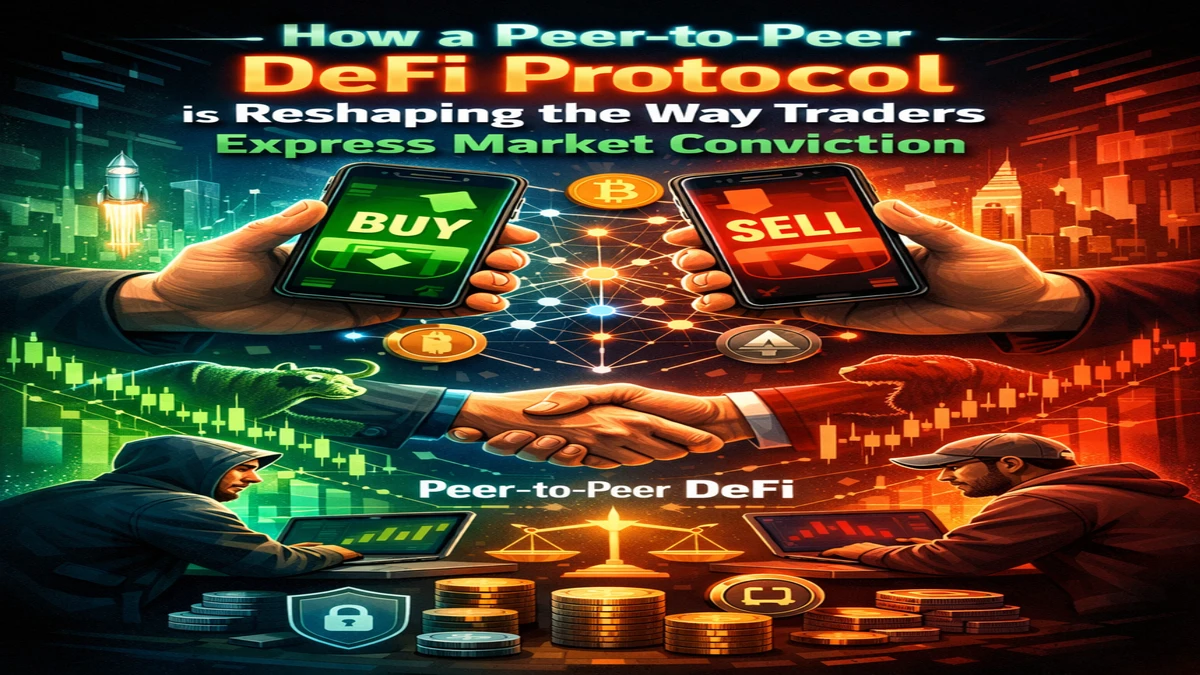
Logium is a decentralized finance protocol that allows people to speculate on the future price direction of crypto tokens through peer-to-peer smart contracts instead of conventional trading. For users searching for Logium, the essential answer is that it is a non-custodial, blockchain-based platform where two participants take opposing positions on whether a token’s price will rise or fall within a defined time window, and the smart contract automatically settles the outcome.
Rather than buying or selling the asset itself, users are entering a prediction agreement. One participant goes long, expecting the price to increase. The other goes short, expecting it to decrease. Both stake funds, and when the time expires, the contract determines the winner using an external price feed and transfers the pooled funds accordingly. This structure makes Logium closer to a decentralized options or prediction market than a traditional exchange.
Logium emerged during the expansion of DeFi derivatives, as traders looked for alternatives to centralized exchanges and complex order books. Its appeal lies in simplicity: no custody, no order matching, no identity verification, and no need to hold the underlying asset. Participants simply connect a wallet, choose a token, set a timeframe, and take a position. The platform reflects a broader movement in crypto toward trust-minimized financial tools that allow users to express market beliefs directly, transparently, and without intermediaries.
The Concept Behind Logium
The idea behind Logium is that markets are not only places of exchange but also places of expectation. Every trade reflects a belief about the future. Logium isolates that belief and turns it into the core financial object. Instead of trading assets, users trade predictions.
This design responds to two structural challenges in crypto markets. First, centralized exchanges introduce custodial risk and regulatory friction. Second, decentralized exchanges require liquidity pools and complex mechanics that are not intuitive for all users. Logium bypasses both by allowing two people to form a direct agreement enforced by code.
This also changes the psychology of participation. Users are not chasing charts or liquidity depth; they are committing to a specific directional view over a specific period. That encourages deliberation rather than constant reaction, aligning with a slower and more intentional model of financial engagement.
How the Protocol Works
Logium operates through smart contracts deployed on a blockchain network. A user selects a token, such as ETH or any ERC-20 asset, chooses a timeframe ranging from one hour to several weeks, and sets an amount to stake. Another user takes the opposite position.
The contract locks both stakes and records the terms. At expiration, the contract checks the token’s price using a decentralized price oracle and determines whether the long or short position was correct. The entire pooled amount is then transferred to the winner.
No central authority can interfere with this process. The code enforces the rules, and the blockchain records the outcome. This removes the need for trust between participants, replacing it with verifiable logic.
| Element | Description |
|---|---|
| Position | Long or short on a token’s price |
| Timeframe | 1 hour to 30 days |
| Settlement | Automatic via smart contract |
| Custody | User wallets, not the platform |
| Verification | On-chain price oracle |
This structure makes Logium functionally simple while conceptually powerful. It transforms price belief into a programmable financial instrument.
Comparison with Traditional Crypto Trading
| Aspect | Logium | Traditional Exchange |
|---|---|---|
| Asset ownership | No need to own the token | Must buy or sell the token |
| Custody | Non-custodial | Usually custodial |
| Liquidity | Provided by participants | Provided by order books or pools |
| Complexity | Simple agreement | Technical trading interfaces |
| Risk type | Directional prediction | Price, liquidity, and counterparty |
This comparison highlights Logium’s distinctiveness. It is not designed for frequent trading or portfolio building but for expressing conviction about future price movement.
Security and Trust
Security in Logium is rooted in transparency. The smart contracts are publicly visible and auditable. Funds remain under user control until committed to a contract. There is no central wallet holding collective assets.
This architecture reduces certain risks but introduces others. Users must trust the smart contract code and the price oracle. There is also market risk from volatility and user risk from misjudging price direction. Logium does not remove risk; it reshapes it.
The platform therefore reflects a philosophical shift in finance from institutional trust to computational trust. The question is not whether the platform will act honestly, but whether the code behaves as written.
Expert Reflections
Economists note that prediction markets aggregate information by allowing people to bet on outcomes. This makes them not just financial tools but informational systems that reflect collective belief.
Blockchain researchers emphasize that smart contracts enable these markets to operate without centralized enforcement, reducing cost and friction.
Behavioral scientists observe that turning beliefs into commitments changes how people think. When users stake value on a prediction, they tend to be more reflective and less impulsive.
These insights frame Logium not just as a product but as an experiment in how financial belief, technology, and human behavior interact.
Adoption and Ecosystem
Logium has grown alongside the broader DeFi ecosystem, integrating with wallet providers and token listings from decentralized exchanges. Its ability to support hundreds of tokens makes it flexible, while its peer-to-peer model keeps it lightweight.
The introduction of demo or virtual modes allows users to learn without financial risk, lowering barriers for newcomers. This educational layer is essential in a space where mistakes can be costly.
As DeFi matures, Logium represents a niche focused on directional conviction rather than asset accumulation, adding diversity to the decentralized financial landscape.
Takeaways
- Logium is a peer-to-peer prediction protocol, not a traditional exchange.
- It allows users to long or short tokens without owning them.
- All agreements are enforced by smart contracts.
- The platform is non-custodial and trust-minimized.
- It reflects a broader shift toward decentralized derivatives.
- It encourages intentional rather than reactive participation.
Conclusion
Logium illustrates how decentralized finance is expanding beyond simple swaps and lending into more abstract financial functions. By turning price expectations into programmable agreements, it allows users to express market beliefs directly, without intermediaries, and with transparent rules.
This does not make markets safer or easier, but it makes them clearer. Users know exactly what they are committing to and what they stand to gain or lose. In a financial world often obscured by complexity and opacity, that clarity is itself a form of innovation.
Whether Logium becomes a major player or remains a niche tool, it represents an important experiment in how financial systems can be reimagined when trust is replaced by code and belief becomes a contract.
FAQs
What is Logium
It is a decentralized protocol for predicting token price direction using smart contracts.
Do I need to own the token
No, you only stake funds on the prediction outcome.
Is Logium custodial
No, users keep control of their funds until a contract executes.
What risks exist
Market volatility, incorrect predictions, and smart contract risk.
Who is Logium for
Traders interested in decentralized, directional price speculation.
References
- Logium. (2022). Logium – Decentralized options protocol. https://www.logium.org/ logium.org
- Cryptorank. (2023, May 18). Logium reviews: Decentralized options protocol? https://cryptorank.io/news/feed/f6d95-188425-logium-reviews-decentralized-protocol CryptoRank
- Investopedia. (n.d.). Decentralized finance (DeFi). https://www.investopedia.com/decentralized-finance-defi-5113835 Investopedia
- Gemini. (2025, December 17). The 2026 ultimate guide to decentralized crypto prediction markets. https://www.gemini.com/cryptopedia/the-ultimate-guide-to-decentralized-crypto-prediction-markets gemini.com
- DappRadar. (n.d.). Logium — DeFi overview and TVL analysis. https://dappradar.com/dapp/logium DappRadar