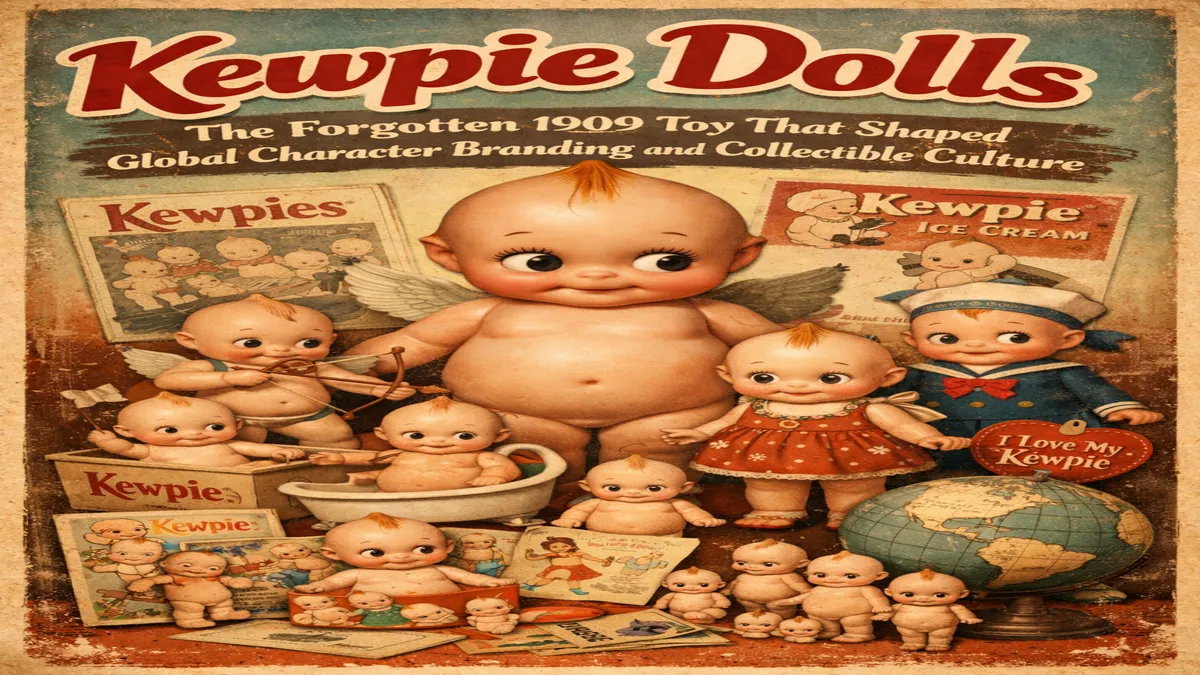
The Kewpie doll began as a drawing, not an object. In 1909, illustrator Rose O’Neill introduced small, round-bellied cherubs in a magazine cartoon, and within a few years those figures escaped the page and entered homes across the world. Today, when people search for “Kewpie doll,” they are usually looking for one of three things: its origin, its cultural meaning, or its value as a collectible. All three answers lead back to the same story of how a single artistic idea became a global commodity and a lasting symbol.
At a time when mass media was still young, the Kewpie represented something new: a character that could move fluidly between art, print, toys, advertising, and politics. The doll was not just a plaything. It was a product of industrial modernity, a piece of visual culture, and a mirror of social change. Its innocent smile coexisted with serious contexts, from the women’s suffrage movement to wartime morale, making it one of the earliest examples of how commercial imagery can carry emotional and ideological weight.
More than a century later, Kewpie dolls still circulate in antique markets, museum collections, and popular culture. They are studied not only by collectors but also by historians, gender scholars, and cultural critics. Understanding the Kewpie doll means understanding how early twentieth-century society blended art and industry, sentiment and sales, innocence and influence. This article traces that story from its artistic birth to its global spread and lasting legacy.
The birth of the Kewpie
Rose O’Neill created the Kewpies as playful, morally gentle figures who did kind deeds in humorous ways. Their exaggerated heads, small bodies, and winged backs made them instantly recognizable. O’Neill’s success as an illustrator was already established when she introduced them, but the Kewpies elevated her into international fame.
The name “Kewpie” was derived from “Cupid,” emphasizing the characters’ role as tiny agents of goodwill. Their appeal lay in their simplicity. They were not tied to a specific story or personality but instead represented a general mood of sweetness, humor, and optimism. This openness made them adaptable, allowing them to appear in jokes, postcards, advertisements, and political cartoons without losing their identity.
Within a few years of their debut, readers were asking for physical versions of the characters. This demand pushed the Kewpies from the realm of illustration into industrial production, marking a critical shift from art to object.
From illustration to object
The first three-dimensional Kewpie dolls were produced in Germany in 1912 using bisque porcelain. O’Neill herself supervised the sculpting process, insisting that the dolls preserve the exact proportions and expressions of her drawings. This insistence on artistic fidelity was unusual for the time and helped maintain the brand’s integrity as it expanded.
The early bisque dolls were fragile, delicate, and relatively expensive. As demand grew, manufacturers introduced composition and later celluloid versions that were cheaper and more durable. This shift allowed Kewpies to reach a broader market, turning them from luxury novelties into mass-market toys.
This transition from handcrafted to industrially produced forms reflects a larger transformation in early twentieth-century consumer culture, where character-based products began to dominate emerging global markets.
Materials and manufacturing
| Era | Material | Cultural meaning |
|---|---|---|
| 1910s | Bisque porcelain | Artistic origin, high collectibility |
| 1920s | Composition | Democratization of ownership |
| 1930s | Celluloid | Global export and affordability |
| Post-1940s | Plastic and vinyl | Durability and nostalgia |
Each material shift represents not just a technical change but a cultural one, reflecting how the Kewpie moved from art object to everyday commodity and finally into nostalgic collectible.
A global phenomenon
The Kewpie craze spread rapidly beyond the United States. The dolls appeared in Europe, Australia, and Asia, adapting to local tastes and production styles. In Japan, in particular, the Kewpie became deeply embedded in popular culture, influencing design aesthetics and even brand identities.
This global spread illustrates how early character merchandising operated long before modern intellectual property systems were formalized. The Kewpie became a shared visual language that crossed borders easily because its meaning was emotional rather than narrative.
The artist behind the doll
Rose O’Neill’s role in this story is central. She was not only a creator but also a businesswoman and activist. Her success challenged gender norms in the commercial art world, and she used her platform to advocate for women’s rights, including suffrage.
The Kewpies appeared in suffrage imagery, sometimes wearing sashes or participating in rallies through illustrations. This blending of innocence and politics softened the presentation of controversial ideas, making them more palatable to a broad audience.
O’Neill’s career demonstrates how commercial success can coexist with social influence, and how a seemingly trivial object can carry deep cultural significance.
Timeline of key moments
| Year | Event |
|---|---|
| 1909 | First Kewpie illustrations appear |
| 1912 | First Kewpie dolls produced |
| 1913 | Global craze begins |
| 1920s | Mass production expands |
| Post-1945 | Kewpies become nostalgic collectibles |
This timeline shows the progression from artistic idea to cultural artifact.
Expert perspectives
Art historians often point out that the Kewpie represents one of the earliest examples of character branding. Cultural critics see it as a case study in how sentimentality can be commercialized. Collectors view it as a bridge between antique craftsmanship and industrial mass production.
Together, these perspectives highlight why the Kewpie remains relevant far beyond the toy market.
Cultural meaning and legacy
The Kewpie doll sits at the intersection of innocence and commerce. It represents a moment when society embraced mass-produced charm without cynicism, when consumers believed that products could carry moral or emotional value.
Over time, the Kewpie shifted from contemporary object to nostalgic symbol. Today, it evokes childhood, simplicity, and a perceived gentler past, even as historians remind us that its era was filled with conflict, inequality, and change.
Takeaways
- The Kewpie began as an illustration, not a toy.
- Its success depended on its emotional universality.
- Material changes reflect cultural and economic shifts.
- Rose O’Neill’s role combined art, business, and activism.
- The Kewpie’s legacy lies in both nostalgia and cultural history.
Conclusion
The Kewpie doll’s enduring appeal lies in its ability to exist in multiple meanings at once. It is a toy, a work of art, a commercial product, a political symbol, and a nostalgic object. Its journey from magazine page to global icon mirrors the rise of modern consumer culture and the power of visual imagery to shape collective emotion.
More than a century later, the Kewpie still smiles from shelves and showcases, reminding us that cultural history is often preserved not only in books and monuments but in the small, playful objects people choose to keep.
FAQs
What is a Kewpie doll?
A doll based on a cartoon character created by illustrator Rose O’Neill in 1909.
Why is it called Kewpie?
The name comes from “Cupid,” reflecting its cherubic design.
Are Kewpie dolls valuable?
Early bisque versions and signed examples can be highly valuable to collectors.
Why are Kewpies associated with Japan?
Japan became a major producer and cultural adopter of the character in the early twentieth century.
Are Kewpies still made today?
Yes, modern versions continue in plastic and vinyl forms.
REFERENCES
- Hirshey, G. (2008, March 16). Who knew? ‘Kewpie Lady’ had quite a colorful life. The New York Times. Smithsonian Magazine
- Knight, M. K. (2011, December 8). The Kewpie Doll. The History Channel Club. Wikipedia
- O’Neill, R. C. (1997). Autobiography. (Referenced in biography overview). Wikipedia
- Smithsonian Magazine. (2018, March 15). Prolific illustrator behind Kewpies used her cartoons… Smithsonian Magazine
- Springfield Art Museum. (2021). Rose O’Neill and the Kewpie Comics Exhibition. sgfmuseum.org
- The International Rose O’Neill Club. (n.d.). History of Kewpie dolls. Kewpie Creator Celebrated
- Thunder Bay Museum. (n.d.). Kewpie Dolls. Thunder Bay Museum
- Conolly, P. (2024). The story of the Kewpie doll.