
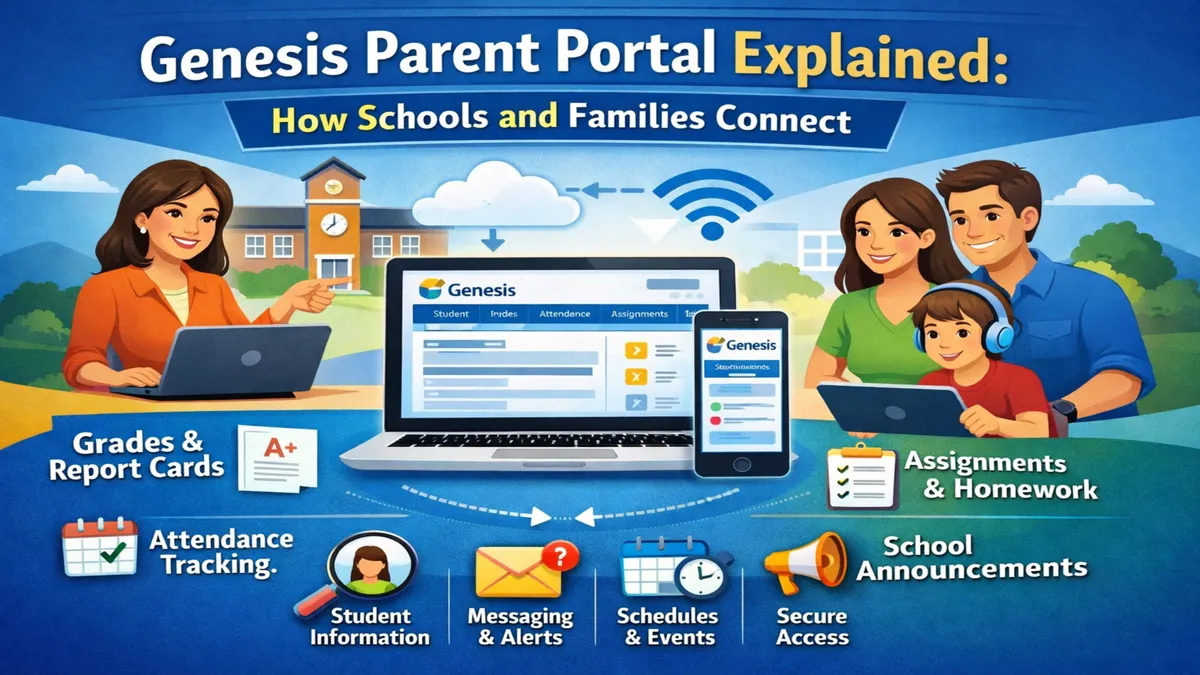
The Genesis Parent Portal has become one of the most influential yet least discussed pieces of infrastructure in American public education. For millions of parents, it is the window into their children’s school lives: a place to check attendance before breakfast, review grades after dinner, and scan announcements late at night. It replaces the folded paper report card, the handwritten note from a teacher, and the occasional phone call from the school office with something more constant, more immediate, and more demanding of attention.
At its core, the Genesis Parent Portal is a secure web interface connected to a school district’s student information system. It allows parents and guardians to see grades, schedules, attendance records, discipline entries, and school forms in near real time. This visibility is meant to strengthen family engagement, reduce misunderstandings, and support student success by keeping everyone informed.
But the portal does more than display information. It subtly shifts power, responsibility, and expectation. When data is always available, silence becomes a signal. A missing assignment no longer waits until the end of the term to surface. An absence is visible before the student gets home. The Genesis Parent Portal changes not only how parents see school, but how school is experienced inside families. It is not simply a tool. It is a new relationship between institutions, parents, and children, built on dashboards, permissions, and the promise of transparency.
The System Behind the Portal
Genesis is a student information system designed to centralize academic and administrative data for school districts. Attendance, schedules, grading, discipline, health information, and state reporting all live inside a single database. The Parent Portal is the outward-facing layer of that system, carefully restricted and filtered so that families see only what they are authorized to see.
This architecture reflects a broader shift in education toward integrated digital infrastructure. Instead of separate systems for attendance, grading, and communication, Genesis combines them into one environment. Teachers enter data once. Administrators use it for compliance and reporting. Parents access a curated subset through the portal.
The portal itself is governed by role-based permissions. Districts decide what parents can view, when they can view it, and how much detail is revealed. Some districts show individual assignment grades, others only marking period averages. Some allow parents to update contact information directly, others restrict changes to office staff. The result is a platform that is technically consistent but socially diverse, reflecting each district’s values and policies.
What Parents Actually See
For parents, the Genesis Parent Portal usually begins with a dashboard. It shows the student’s name, school, grade level, and a set of tabs or links to deeper information. Attendance is often the first stop. Parents can see whether their child was present, absent, late, or excused, sometimes down to individual class periods.
Grades are the emotional center of the portal. They appear as percentages, letter grades, or numerical scores depending on district configuration. Parents can often click into each course to see individual assignments, due dates, and scores. This transforms grading from a periodic event into a continuous stream.
Schedules show where a student is supposed to be during the day and who is teaching them. Report cards appear as downloadable documents. Discipline entries may appear as coded incidents with dates and brief descriptions. Forms and documents, once sent home in backpacks, now appear as digital checkboxes.
This information is neutral in appearance but powerful in effect. It creates a shared reference point between parents and children. It allows questions to be specific, timely, and sometimes uncomfortable.
The Cultural Shift Toward Transparency
The Genesis Parent Portal embodies a cultural shift toward transparency in institutions. Schools once controlled the timing and framing of information. Parents received updates at conferences, through mailed reports, or after a problem had grown large enough to require intervention.
Now, information flows continuously. This has benefits. Parents can support struggling students earlier. Attendance issues can be addressed before they become chronic. Miscommunications can be corrected quickly.
But transparency also creates pressure. Students know they are visible. Parents feel compelled to monitor. Teachers feel watched, even when the watching is passive. The portal becomes a space where trust and surveillance coexist uneasily.
Some families embrace this. Others negotiate boundaries, choosing how often to check and what to discuss. The portal does not dictate behavior, but it invites it.
Comparison With Older Systems
| Aspect | Before Digital Portals | With Genesis Parent Portal |
|---|---|---|
| Grade visibility | End of term | Continuous |
| Attendance awareness | After problems | Same day |
| Parent-teacher contact | Scheduled | Ongoing |
| Student privacy | Higher | Reduced |
| Stakeholder | Main Benefit | Main Tension |
|---|---|---|
| Parents | Awareness | Overmonitoring |
| Students | Support | Pressure |
| Teachers | Fewer surprises | Feeling scrutinized |
| Schools | Fewer disputes | Increased expectations |
Expert Perspectives
“Parent portals change the rhythm of family-school interaction from episodic to continuous.” — Dr. Emily Lawson, educational technology researcher.
“When data is always available, it stops being information and becomes environment.” — Prof. Mark Riley, sociologist of education.
“Transparency is not neutral; it redistributes power and responsibility in subtle ways.” — Aisha Gupta, data governance specialist.
Equity and Access
Not all families experience the Genesis Parent Portal equally. Access depends on reliable internet, devices, and digital literacy. Families with multiple jobs, language barriers, or limited connectivity may not benefit in the same way as those with time and technical confidence.
Districts attempt to mitigate this through training sessions, multilingual support, and alternative communication methods. But the risk remains that transparency can amplify inequality, advantaging those already better positioned to respond.
At the same time, for some families the portal is a lifeline. It provides clarity where communication was once opaque. It offers reassurance, especially for parents who cannot physically be present at school.
The Emotional Layer
Behind every login is a parent’s hope, anxiety, pride, or worry. A green checkmark for attendance can be comforting. A low grade can trigger concern or conflict. The portal is not emotionally neutral. It carries weight.
Over time, families develop rituals around it. Some check daily. Others avoid it until necessary. Some use it as a conversation starter. Others as a silent observer. These practices shape family dynamics as much as the data itself.
Takeaways
- The Genesis Parent Portal centralizes school data for families.
- It shifts communication from periodic to continuous.
- It enhances transparency but introduces new pressures.
- Its impact depends on access, literacy, and family culture.
- It reshapes trust, responsibility, and engagement in education.
Conclusion
The Genesis Parent Portal is not just a piece of software. It is a quiet reconfiguration of how families and schools relate to each other. It makes information abundant, visible, and immediate. In doing so, it changes expectations, behaviors, and emotions on all sides.
Its success cannot be measured only in logins or reduced paperwork. It must be understood in the conversations it provokes, the interventions it enables, and the tensions it introduces. Like any powerful tool, it reflects the values of those who use it. It can empower or overwhelm, connect or intrude.
In the end, the Genesis Parent Portal reveals something deeper than academic data. It reveals how modern institutions are renegotiating trust in a digital age, one login at a time.
FAQs
What is the Genesis Parent Portal?
It is a secure online system that shows parents student grades, attendance, schedules, and school information.
Who controls what parents see?
School districts configure the portal and decide which data fields are visible.
Does it replace parent-teacher communication?
No. It supplements it by providing shared information.
Can it increase student pressure?
Yes, if used excessively or without context.
Is it available everywhere?
No. Only in districts that adopt the Genesis system.
References
- Genesis SIS Support. (2025). Parent Portal overview. https://support-sis.genesisedu.com/support/solutions/articles/151000078769-parent-portal-overview Genesis SIS Support
- Montclair Public Schools. (n.d.). Genesis for parents. https://www.montclair.k12.nj.us/parentaccess montclair.k12.nj.us
- Belmar K–12. (n.d.). Genesis Parent Portal login. https://belmar.k12.nj.us/genesis-parent-portal/ belmar.k12.nj.us
- Ewing K–12. (n.d.). Genesis Parent/Student access. https://www.ewing.k12.nj.us/district-information/information-technology/genesis-parentstudent-access Ewing Township Board of Education
- Springfield Schools. (n.d.). Genesis Parent Portal support. https://www.springfieldschools.com/genesis-parent-portal-support springfieldschools.com
- Livingston Public Schools. (n.d.). Parent portals general information. https://www.livingston.org/parent-resources/general-information/parent-portals Livingston Public Schools
- Lawrence Township Public Schools. (n.d.). Genesis overview. https://www.ltps.org/parents/genesis-parent-access/genesis-overview ltps.org