Business intelligence exercises are practical learning activities designed to teach people how to transform raw data into meaningful insight. In the first moments of exposure, they answer a simple but urgent question: how do organizations actually use data to make decisions? These exercises simulate real analytical work—cleaning messy datasets, writing queries, building dashboards, and explaining results to stakeholders—so learners are not merely studying concepts but practicing judgment.
Unlike abstract theory, business intelligence exercises are rooted in business reality. They reflect the everyday problems faced by analysts in marketing, finance, healthcare, education, logistics, and government. A sales manager wants to know why revenue declined in one region. An operations team needs to forecast demand. An executive wants a dashboard that explains performance in seconds, not hours. Exercises recreate these scenarios in controlled environments where mistakes are instructive rather than costly.
Over the past decade, the rise of self-service analytics tools has expanded the audience for business intelligence. No longer limited to specialized data teams, BI is now used by managers, consultants, and frontline professionals. Exercises serve as the bridge between access and competence, ensuring that access to data does not result in misinterpretation or superficial conclusions.
This article examines business intelligence exercises as a discipline: what they are, how they are structured, the skills they develop, and why they matter. Drawing on established practice frameworks, expert perspectives, and realistic scenarios, it offers a comprehensive guide to understanding how deliberate practice turns analytics tools into strategic capability.
The Purpose of Business Intelligence Exercises
At their core, business intelligence exercises exist to develop analytical thinking under realistic constraints. They are not simply about learning how to click through software menus. Instead, they focus on the reasoning process that turns data into decisions. Each exercise typically follows a sequence: define a question, acquire relevant data, prepare that data, analyze patterns, and communicate results.
This structure mirrors how business intelligence functions in professional environments. Analysts rarely receive perfect datasets or clear instructions. Exercises replicate ambiguity, forcing participants to decide what matters, what to ignore, and how to frame findings responsibly. Through repetition, learners build confidence in navigating uncertainty.
Another central purpose is skill integration. Business intelligence requires a combination of technical, statistical, and communication skills. Exercises intentionally combine these elements. A learner might write SQL queries, design a dashboard, and then summarize findings in plain language. The exercise is incomplete if any part of this chain fails.
Just as importantly, BI exercises teach restraint. Not every chart is useful, and not every correlation is meaningful. Practice helps learners recognize when data supports a conclusion and when it does not. Over time, this discipline reduces the risk of misleading analysis in real organizational contexts.
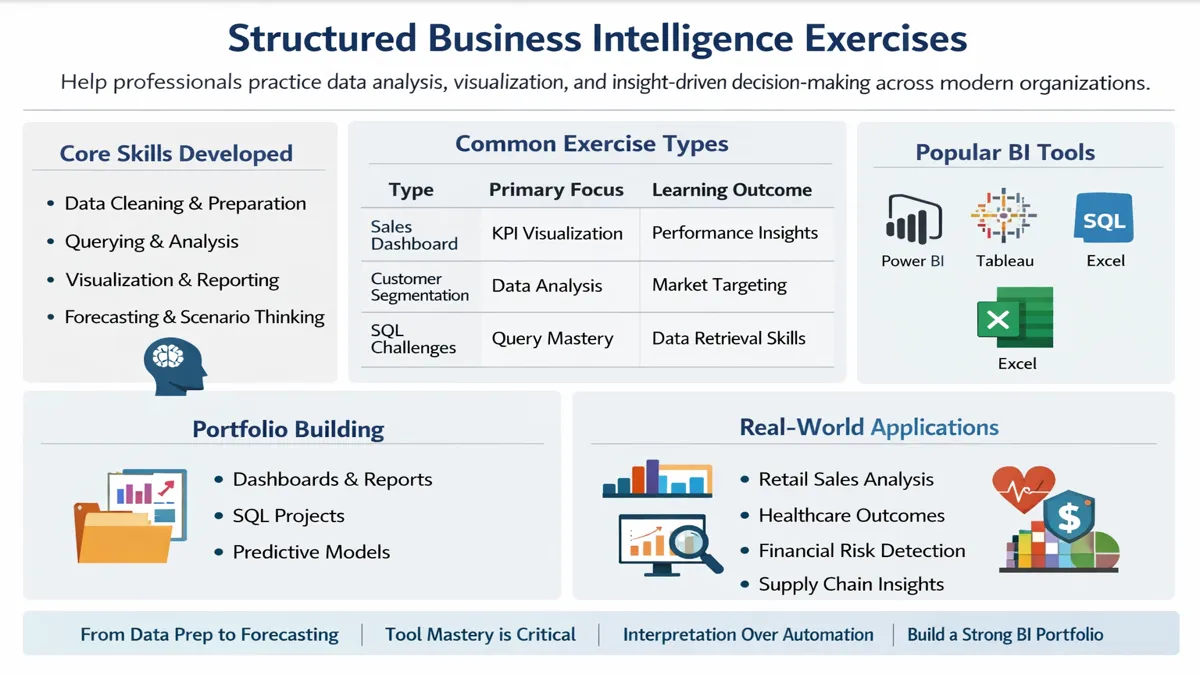
Core Skill Categories Developed Through BI Practice
Business intelligence exercises are typically organized around distinct but interconnected skill categories. Understanding these categories clarifies why exercises are sequenced the way they are.
Data Preparation and Cleaning
Before analysis begins, data must be made usable. Exercises in this category focus on identifying missing values, correcting inconsistencies, standardizing formats, and validating accuracy. Learners discover that most analytical effort happens before visualization, not after it.
Querying and Data Retrieval
Query-focused exercises emphasize extracting the right data efficiently. Learners practice joining tables, aggregating metrics, filtering time periods, and calculating derived values. These drills build precision and reduce dependence on pre-built reports.
Analysis and Interpretation
Analytical exercises focus on identifying trends, comparisons, and anomalies. Learners explore questions such as growth over time, segment performance, and variance against targets. Interpretation, not calculation, is the central outcome.
Visualization and Communication
Visualization exercises emphasize clarity over decoration. Learners practice choosing appropriate chart types, designing dashboards, and sequencing insights so that non-technical audiences can understand results quickly.
Forecasting and Scenario Thinking
Advanced exercises introduce predictive elements such as trend extrapolation and scenario modeling. These drills teach caution, helping learners understand uncertainty and assumptions rather than presenting forecasts as certainties.
Common Types of Business Intelligence Exercises
Different exercises emphasize different competencies. The table below outlines common BI exercise types and their primary learning outcomes.
| Exercise Type | Primary Focus | Learning Outcome |
|---|---|---|
| Sales Performance Dashboard | Visualization and KPIs | Communicating performance clearly |
| Customer Segmentation | Data analysis | Identifying meaningful groups |
| SQL Query Challenges | Data retrieval | Accuracy and efficiency |
| Trend Analysis | Interpretation | Understanding change over time |
| Forecast Scenarios | Predictive reasoning | Managing uncertainty |
These exercises are often combined into projects, where learners must move from raw data to executive-level summaries. The value lies not in any single task but in the continuity between them.
Tools Commonly Used in BI Exercises
Business intelligence exercises are tool-agnostic in principle but tool-specific in practice. Different platforms emphasize different aspects of the workflow.
| Tool | Typical Use in Exercises | Strength Emphasized |
|---|---|---|
| Power BI | Interactive dashboards | Integrated workflow |
| Tableau | Visual storytelling | Design and narrative |
| SQL | Query exercises | Data precision |
| Excel | Prototyping analysis | Flexibility and speed |
Exercises are often designed to expose the strengths and limitations of each tool. Learners discover that no single platform solves every problem and that tool choice influences analytical approach.
Designing Effective Business Intelligence Exercises
Well-designed BI exercises share several characteristics. First, they are grounded in realistic questions rather than artificial puzzles. A good exercise starts with a business concern, not a technical trick.
Second, effective exercises are constrained. Time limits, incomplete data, and ambiguous objectives reflect real-world pressures. These constraints force prioritization and judgment.
Third, feedback is essential. Exercises should conclude with reflection: what worked, what failed, and what assumptions influenced conclusions. Without reflection, repetition does not translate into learning.
Finally, progression matters. Exercises should move from foundational skills to integrated projects. Jumping directly into complex dashboards without understanding data preparation often results in superficial competence.
Expert Perspectives on BI Practice
Experts in analytics education consistently emphasize practice as the defining factor in skill development.
One industry trainer notes that business intelligence cannot be learned passively. Tools change rapidly, but analytical reasoning develops through repeated exposure to realistic problems. Exercises create muscle memory that theory alone cannot provide.
Another practitioner highlights communication as the most overlooked skill in BI exercises. Dashboards are only valuable if they answer real questions. Exercises that require written or verbal explanation of insights reveal gaps in understanding more clearly than technical tests.
A third expert emphasizes ethical responsibility. Exercises should include discussions about data limitations, bias, and appropriate interpretation. Learning when not to draw conclusions is as important as learning how to find patterns.
Applying BI Exercises Across Industries
Business intelligence exercises are adaptable across sectors, reflecting the universality of data-driven decision-making.
Retail and Consumer Goods
Retail exercises often focus on sales trends, inventory turnover, and customer behavior. Learners analyze seasonal patterns, promotion effectiveness, and regional variation. These drills emphasize fast interpretation and operational relevance.
Healthcare and Public Services
In healthcare contexts, exercises may simulate patient flow, resource allocation, or outcome tracking. The emphasis is on accuracy, context, and ethical interpretation, reflecting the high stakes of decision-making.
Finance and Risk Management
Financial BI exercises focus on variance analysis, forecasting, and anomaly detection. Learners practice distinguishing signal from noise and understanding the implications of uncertainty.
Education and Nonprofits
Exercises in these sectors often emphasize impact measurement and reporting to stakeholders. Learners practice balancing quantitative metrics with qualitative context.
Building a Portfolio Through BI Exercises
One of the most practical outcomes of sustained BI practice is a professional portfolio. Exercises produce tangible artifacts: dashboards, reports, queries, and models. When curated thoughtfully, these artifacts demonstrate both technical ability and analytical judgment.
A strong portfolio does not simply show results. It explains the question, the approach, the assumptions, and the implications. Exercises that include narrative summaries prepare learners to communicate with decision-makers rather than only with peers.
Portfolios built from exercises also reveal growth over time. Early work may focus on correctness, while later projects demonstrate clarity, efficiency, and strategic framing. This progression is often more persuasive than credentials alone.
Common Pitfalls in BI Exercises
Despite their value, BI exercises can fail if poorly designed or executed. One common pitfall is overemphasis on tools at the expense of reasoning. Learners may produce visually impressive dashboards that answer no meaningful question.
Another risk is artificial cleanliness. Exercises that rely exclusively on perfectly prepared datasets do not prepare learners for real environments. Messy data is not an inconvenience; it is the norm.
Finally, exercises can become repetitive if they do not evolve. Repeating similar dashboards without increasing complexity leads to stagnation. Progression and variation are essential to sustained learning.
The Strategic Value of BI Exercises
Organizations that invest in BI training often underestimate the importance of practice. Sending employees to workshops without follow-up exercises rarely produces lasting change. Structured exercises embedded into workflows, however, reinforce learning and improve decision quality over time.
At an organizational level, shared exercises create common analytical language. Teams learn to interpret metrics consistently, reducing confusion and misalignment. Over time, this consistency becomes a competitive advantage.
Takeaways
- Business intelligence exercises translate theory into decision-ready skills.
- Effective exercises integrate technical, analytical, and communication abilities.
- Realistic constraints and ambiguity improve judgment.
- Tool proficiency matters, but reasoning matters more.
- Portfolios built from exercises demonstrate real-world readiness.
- Reflection and progression are essential for long-term mastery.
Conclusion
Business intelligence exercises are the quiet engine behind effective analytics. They transform access to data into the ability to act on it responsibly. Through structured practice, learners move beyond surface-level reporting toward genuine insight, learning not just how to analyze data but how to think with it.
In a business environment increasingly shaped by metrics, dashboards, and forecasts, the difference between noise and knowledge lies in disciplined practice. Exercises provide that discipline. They teach patience, skepticism, and clarity. They reveal that good analysis is less about tools and more about judgment.
As organizations continue to expand their data capabilities, the role of exercises becomes even more important. Tools will evolve, datasets will grow, and expectations will rise. The foundational habits built through thoughtful BI exercises, however, will remain the most reliable guide through complexity.
FAQs
What are business intelligence exercises?
They are structured practice tasks that simulate real data analysis scenarios, helping learners develop analytical, technical, and communication skills.
Who should practice BI exercises?
Students, analysts, managers, and professionals who use data for decision-making all benefit from structured BI practice.
Are BI exercises only technical?
No. They emphasize interpretation, judgment, and communication as much as technical execution.
How advanced can BI exercises become?
Exercises range from basic data cleaning to advanced forecasting and scenario modeling.
Do BI exercises help with careers?
Yes. They build portfolios, confidence, and real-world competence valued by employers.