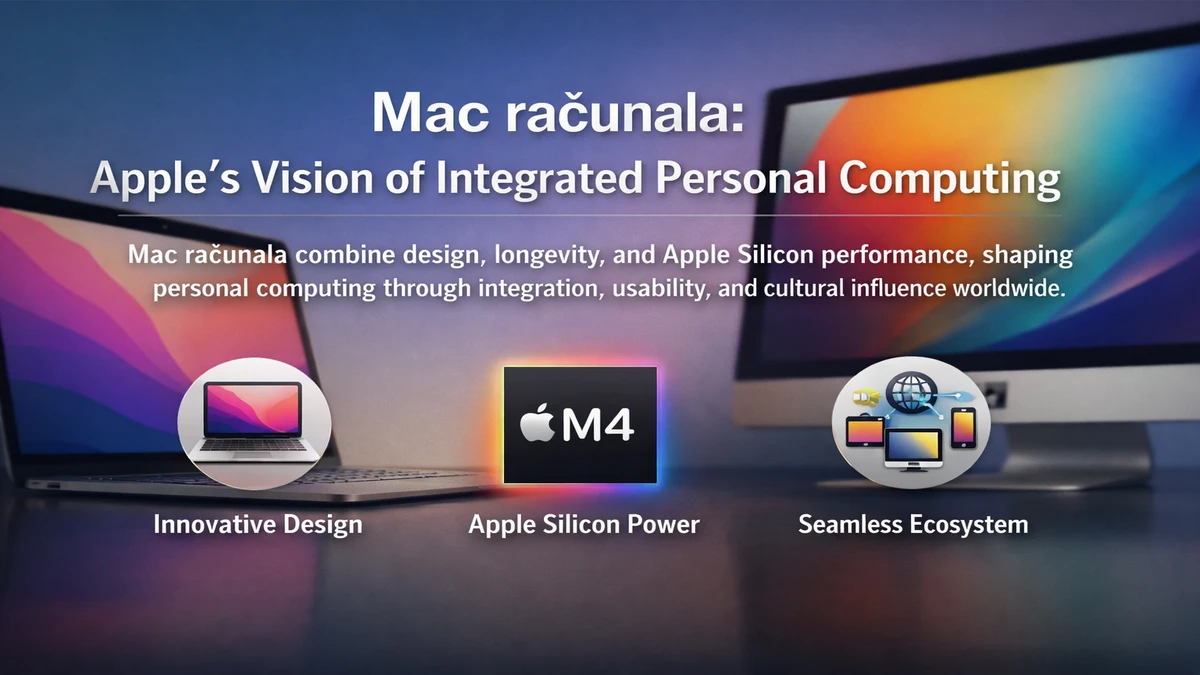
Mac računala are Apple’s personal computers, a family of devices that includes laptops and desktops unified by macOS and Apple-designed hardware. For readers searching for clarity, the essential answer is simple: Macs are computers built by Apple that emphasize tight hardware–software integration, long-term performance, and a distinctive design philosophy. Yet that definition barely captures why Macs matter. Over four decades, they have shaped how people write, design, edit, program, study, and communicate, often setting standards that competitors later follow.
The story of Mac računala begins not with market dominance, but with an idea that computing should feel humane. When the Macintosh debuted in 1984, it introduced a graphical interface, icons, windows, and a mouse to a mass audience. This decision permanently altered the direction of personal computing. While Macs have never held the largest market share, their influence has consistently outweighed their numbers. Designers, educators, scientists, and creative professionals adopted them early, drawn by reliability and visual clarity.
Today’s Macs span ultraportable laptops, compact desktops, and workstation-class machines powered by Apple Silicon. They operate inside an ecosystem that connects seamlessly with iPhones, iPads, and cloud services. Understanding Mac računala means understanding Apple’s long-term strategy: control the entire experience, iterate patiently, and prioritize cohesion over short-term compatibility. That strategy has made the Mac both enduring and distinct in a crowded technological landscape.
Origins of the Macintosh Vision
The Macintosh was born from dissatisfaction with how computers felt to use. In the late 1970s and early 1980s, most personal computers required typed commands and technical knowledge. Apple engineers envisioned something radically different: a computer ordinary people could use intuitively. This vision culminated in the Macintosh 128K, an all-in-one machine with a built-in screen, graphical interface, and mouse.
Early Macs ran classic Mac OS and relied on Motorola processors. They were limited in memory and expensive compared with competitors, but they introduced concepts that became universal: drag-and-drop files, menus, icons, and visual metaphors. While initial sales were uneven, the Macintosh established Apple as a company willing to challenge conventions even at commercial risk.
Throughout the late 1980s and early 1990s, Mac računala found a foothold in education and publishing. Desktop publishing software, paired with Apple’s displays and printers, turned the Mac into a creative workhorse. This period cemented a cultural association between Macs and creative work that still persists today.
Processor Transitions and Strategic Control
Few computer platforms have undergone as many fundamental architectural shifts as the Mac. These transitions reveal Apple’s willingness to disrupt its own products to maintain long-term advantages. In the mid-1990s, Apple moved from Motorola processors to PowerPC chips, seeking better performance and efficiency. This transition strengthened Macs in professional environments, particularly in graphics and media production.
A decade later, Apple made another bold decision: transitioning Macs to Intel processors. This move improved performance consistency and allowed Macs to run Windows, easing adoption in mixed computing environments. For many users, this era made the Mac feel less isolated from the broader PC world.
The most consequential transition arrived in 2020, when Apple introduced Apple Silicon. By designing its own processors, Apple gained full control over performance, power efficiency, and system integration. Apple Silicon combined CPU, GPU, memory, and machine-learning components into a single architecture. The result was dramatic gains in battery life, speed, and thermal efficiency. This shift redefined expectations for laptops and desktops alike and marked a return to Apple’s preference for vertical integration.
macOS and the Software Philosophy
macOS is central to the Mac identity. Built on a Unix foundation, it balances power with approachability. From its early days as Mac OS X, the operating system emphasized stability, visual consistency, and thoughtful defaults. Rather than overwhelming users with configuration options, macOS prioritizes sensible design choices that work well out of the box.
Over time, macOS introduced features that became deeply associated with the Mac experience: system-wide search, automatic backups, sandboxed applications, and strong permission controls. Security and privacy are embedded at the system level, reducing reliance on third-party solutions. Updates are delivered consistently and typically support hardware for many years, reinforcing the perception of longevity.
Equally important is how macOS aligns with Apple’s hardware. Because Apple controls both, optimizations are precise. Animations, power management, and application behavior are tuned for specific machines. This alignment explains why Macs often feel responsive even as they age, and why software updates tend to improve performance rather than degrade it.
Design, Materials, and Longevity
Design has always been inseparable from Mac računala. Apple’s approach favors minimalism, durability, and clarity. Aluminum unibody construction replaced plastic enclosures, improving rigidity and thermal management. High-resolution displays set standards for color accuracy and text clarity long before such features became common elsewhere.
Design choices are rarely cosmetic alone. Large trackpads enabled gesture-based navigation that became integral to macOS. Quiet cooling systems reduced distraction in professional settings. Consistent keyboard layouts and ports emphasized familiarity across generations. These decisions contributed to a sense that Macs are tools meant to be lived with, not replaced annually.
Longevity is one of the Mac’s defining characteristics. Many users keep Macs for years, relying on continued software support and stable performance. This longevity offsets higher upfront costs and reinforces trust in the platform. In an industry often driven by rapid obsolescence, the Mac’s durability stands out.
The Mac Product Line Explained
| Mac Model | Primary Role | Typical Use Case |
|---|---|---|
| MacBook Air | Ultra-portable laptop | Students, travelers, everyday work |
| MacBook Pro | High-performance laptop | Developers, creatives, professionals |
| iMac | All-in-one desktop | Home offices, education |
| Mac mini | Compact desktop | Small offices, servers |
| Mac Studio | Power desktop | Video, audio, 3D production |
| Mac Pro | Modular workstation | Enterprise, specialized workflows |
| Aspect | Mac računala | Typical PC |
|---|---|---|
| Operating system | macOS | Windows or Linux |
| Hardware control | Single manufacturer | Multiple vendors |
| Update longevity | Long-term support | Varies widely |
| Ecosystem integration | Deep, seamless | Fragmented |
| Design consistency | High | Inconsistent |
Ecosystem Integration and Continuity
One of the Mac’s most powerful advantages lies beyond the computer itself. Macs are designed to work as part of a broader Apple ecosystem. Files, messages, photos, and tasks flow effortlessly between devices. A document started on a phone can be edited on a Mac within seconds. Calls and messages appear across screens. Input devices can control multiple machines simultaneously.
This continuity reduces friction and encourages focus. Rather than managing devices separately, users experience them as extensions of a single digital environment. For professionals, this integration saves time. For casual users, it reduces complexity. The Mac often becomes the central hub of this ecosystem, anchoring more mobile devices with greater processing power and storage.
The ecosystem also reinforces loyalty. Once users experience seamless continuity, switching platforms becomes less appealing. This network effect strengthens the Mac’s position even when competing devices offer comparable specifications.
Market Presence and Cultural Meaning
Mac računala have never dominated global PC sales, yet their cultural footprint is substantial. In education, Macs symbolize learning and creativity. In media and design industries, they remain deeply entrenched. Film editing suites, recording studios, and design agencies frequently standardize on Macs, valuing reliability and software ecosystems built around them.
The Mac’s cultural meaning extends beyond work. It represents a philosophy of technology that prioritizes experience over raw specifications. Advertising and popular media have reinforced this image, portraying Macs as tools for people who create rather than merely consume.
Market data shows that while Macs occupy a minority share, their presence is stable and often growing in premium segments. Apple’s focus on profitability rather than volume allows the Mac to thrive without chasing low-cost markets. This positioning aligns with Apple’s broader brand identity.
Expert Perspectives on the Mac
Technology analysts frequently note that Apple’s strength lies in integration rather than innovation in isolation. By refining existing ideas and executing them cohesively, Apple creates products that feel complete. The Mac exemplifies this approach, combining mature technologies into systems that emphasize reliability and polish.
Design scholars often highlight the Mac as a case study in industrial design, where form and function evolve together. The Mac’s visual restraint communicates confidence, while its usability reflects deep user research rather than trend chasing.
From a software engineering perspective, the Mac demonstrates the advantages of controlling hardware targets. Developers can optimize applications for known configurations, improving stability and performance. This predictability benefits both creators and users.
Takeaways
- Mac računala are defined by integration of hardware, software, and services.
- Apple’s processor transitions reflect long-term strategic control.
- macOS emphasizes stability, security, and usability over customization.
- Design decisions prioritize longevity and everyday experience.
- The Apple ecosystem amplifies the Mac’s value beyond standalone use.
- Cultural influence outweighs market share.
Conclusion
Mac računala occupy a singular place in the history of personal computing. They are not merely alternatives to other computers, but expressions of a different philosophy—one that values cohesion, patience, and human-centered design. From the first Macintosh to modern Apple Silicon machines, the Mac has evolved while remaining true to its origins.
Its influence can be seen across the industry in graphical interfaces, industrial design, and integrated ecosystems. While competition continues to intensify, the Mac’s clarity of purpose remains intact. It serves users who value reliability, thoughtful design, and tools that fade into the background of creative work. In that quiet consistency lies the enduring power of the Mac.
FAQs
What are Mac računala?
Mac računala are personal computers made by Apple that run macOS and emphasize integrated hardware and software design.
Why are Macs considered long-lasting?
Apple provides extended software support and designs hardware for durability, allowing Macs to remain useful for many years.
Can Macs be used for professional work?
Yes. Macs are widely used in programming, design, video production, music, education, and scientific research.
What makes macOS different?
macOS focuses on stability, security, and seamless integration with Apple hardware and services.
Are Macs only for creative users?
No. While popular among creatives, Macs are also used in business, education, and everyday personal computing.