
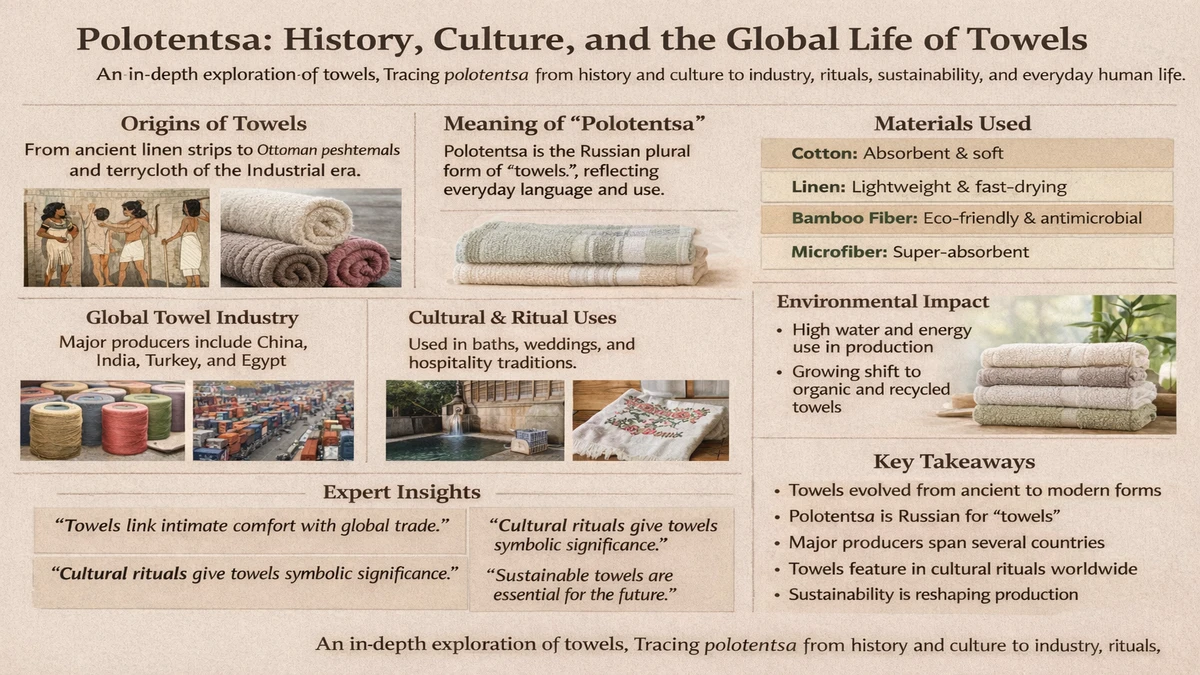
Few objects are as universally present—and as rarely contemplated—as the towel. Known in Russian as polotentsa, the plural form of polotentse, towels exist at the intersection of the personal and the global. They dry our hands, absorb our sweat, clean our homes, and signal comfort and care in public spaces. Within the first moments of encountering this topic, the central truth becomes clear: polotentsa are not merely textiles but vessels of history, culture, labor, and meaning.
At a glance, a towel appears simple—fabric cut, stitched, and folded. Yet behind that simplicity lies a dense story of evolving hygiene practices, international trade routes, linguistic exchange, and technological progress. From ancient bathing rituals to modern hospitality standards, towels have shaped how societies think about cleanliness, privacy, and dignity. They are among the first objects handed to guests and among the last to touch us at the end of the day.
Understanding polotentsa means understanding how an everyday item can reflect broader systems: agriculture and water use, factory labor and global markets, sustainability pressures and consumer values. It also means recognizing how deeply towels are embedded in culture—wrapped around bodies in bathhouses, folded carefully in kitchens, embroidered for ceremonies, or standardized for hotels. This article explores polotentsa as cultural artifacts, industrial products, and intimate companions of daily life, revealing how much of the human story can be found in something we usually take for granted.
Origins and Early History of Towels
Long before the modern towel existed, humans used woven cloths to dry their bodies and clean surfaces. In ancient Egypt, linen strips served hygienic purposes after bathing, reflecting both practicality and social status. In ancient Greece and Rome, bathing culture was central to public life, and cloths were essential tools within bathhouses, used for drying and cleansing after immersion.
The transformation of these early cloths into something resembling today’s towel occurred gradually. A major turning point came during the era of the Ottoman Empire, where the peshtemal emerged as a lightweight, woven cotton towel used in communal bathhouses known as hammams. These towels were functional—absorbent yet quick-drying—but also symbolic, representing hospitality, cleanliness, and ritualized care of the body.
As textile technologies advanced in Europe during the Industrial Revolution, terrycloth was developed. Its looped weave dramatically increased absorbency, reshaping expectations of what a towel could do. This innovation marked the transition from multipurpose cloths to specialized towels, designed explicitly for drying the body. From that moment, towels became standardized household items, spreading across continents as industrial manufacturing expanded.
Language and Meaning: The Word Polotentsa
The Russian word polotentsa reflects how deeply towels are embedded in daily life. Its singular form, polotentse, is used casually and frequently, underscoring the object’s ordinariness. Yet linguistic history reveals layers of cultural exchange. In English, the word “towel” traces back to Old French, where it referred broadly to cloths used for washing or wiping.
Across cultures, towels have acquired unique names and connotations. In Japan, the tenugui functions as a hand towel, head covering, or decorative object. In Mediterranean and North African regions, the fouta retains its roots in bathhouse culture while serving modern purposes as a beach towel or wrap. Each term reflects not only function but cultural values, climate, and social customs.
Language turns towels into markers of identity. The way societies name and categorize towels mirrors how they organize domestic life, public hygiene, and hospitality. In this sense, polotentsa is more than a noun—it is a linguistic signpost pointing to shared human routines.
Materials and Textile Evolution
| Material | Key Properties | Common Uses |
|---|---|---|
| Cotton (terry) | Highly absorbent, soft texture | Bath and hand towels |
| Linen | Lightweight, fast-drying | Kitchen and decorative towels |
| Bamboo fiber | Antimicrobial, sustainable | Spa and face towels |
| Microfiber | Extremely absorbent, compact | Sports and travel towels |
Cotton remains the dominant material in towel production, prized for its absorbency and comfort. Long-staple cotton varieties are especially valued, producing smoother and more durable towels. Linen, though less plush, offers quick drying and durability, making it a traditional choice for kitchens and warm climates.
Recent decades have introduced alternative materials. Bamboo fibers appeal to environmentally conscious consumers, while microfiber towels meet the needs of athletes and travelers. These material choices reflect shifting priorities—comfort, performance, sustainability—and show how polotentsa continue to evolve alongside consumer values.
Towels as a Global Industry
| Region | Role in Production | Characteristics |
|---|---|---|
| East Asia | Large-scale manufacturing | High volume, diverse product range |
| South Asia | Major exporter | Skilled labor, cotton availability |
| Middle East | Heritage production | Traditional weaving techniques |
| North Africa | Premium materials | Long-staple cotton focus |
The towel industry is a significant segment of the global textile economy. From cotton fields to spinning mills, dye houses to retail shelves, towels move through complex supply chains. Millions of workers are involved in growing fibers, weaving fabrics, finishing products, and distributing them worldwide.
Hotels, hospitals, gyms, and households drive consistent demand. Hospitality standards, in particular, have elevated towel quality into a marker of service excellence. Plushness, weight, and appearance are now carefully calibrated to meet consumer expectations, turning polotentsa into strategic products rather than simple necessities.
Cultural Rituals and Social Meaning
In many cultures, towels occupy ceremonial space. In communal bathhouses, towels signal entry into a shared ritual of cleansing. In weddings and family traditions, embroidered towels may be given as gifts, symbolizing care, domestic life, and continuity.
Hospitality is another realm where towels carry meaning. Offering a clean towel to a guest communicates welcome, respect, and attention. In professional settings—spas, salons, and hotels—towels become part of the experience, shaping perceptions of cleanliness and luxury.
Even in private homes, towels reflect values. How they are folded, stored, or displayed often mirrors attitudes toward order, comfort, and self-care. Polotentsa thus operate quietly as social signals, communicating norms without words.
Environmental and Sustainability Challenges
Towel production is resource-intensive. Cotton cultivation requires significant water, and conventional dyeing processes contribute to chemical runoff. As awareness of environmental impact grows, the towel industry faces pressure to change.
Manufacturers are increasingly adopting organic fibers, low-impact dyes, and recycled materials. Consumers, in turn, are reconsidering how many towels they own, how often they wash them, and how long they keep them. Sustainability transforms polotentsa from disposable commodities into long-term investments in responsible living.
Expert Perspectives
Textile historians note that towels represent a rare blend of intimacy and industry. Economists view them as indicators of broader trends in global trade and labor. Sustainability researchers highlight towels as a case study in balancing comfort with environmental responsibility. Together, these perspectives reveal towels as far more complex than their everyday appearance suggests.
Takeaways
- Polotentsa is the Russian plural word for towels, deeply embedded in daily life
- Towels evolved from ancient cloths to specialized terrycloth through cultural and technological shifts
- Language and naming reflect cultural uses and values
- Cotton dominates production, but alternative materials are growing
- Towels form a significant global industry tied to hospitality and health
- Cultural rituals elevate towels beyond utility
- Sustainability is reshaping how towels are produced and used
Conclusion
The story of polotentsa unfolds quietly, woven into routines so familiar they often escape notice. Yet within these everyday textiles lies a remarkable convergence of history, culture, labor, and care. Towels accompany humanity through moments of vulnerability and comfort, public ritual and private routine. They reflect how societies value cleanliness, hospitality, and responsibility toward the environment.
By examining polotentsa closely, we uncover a broader truth: ordinary objects often carry extraordinary stories. In recognizing the depth of something as simple as a towel, we learn to see daily life itself with greater clarity and respect.
FAQs
What does polotentsa mean?
It is the Russian plural form of polotentse, meaning towels.
When did towels originate?
Cloths for drying existed in ancient civilizations, while modern towels developed through Ottoman and industrial-era innovations.
What materials are towels made from?
Common materials include cotton, linen, bamboo fibers, and microfiber.
Why are towels important in culture?
They play roles in rituals, hospitality, hygiene, and social signaling.
Are towels environmentally impactful?
Yes, especially conventional cotton towels, though sustainable alternatives are expanding.