
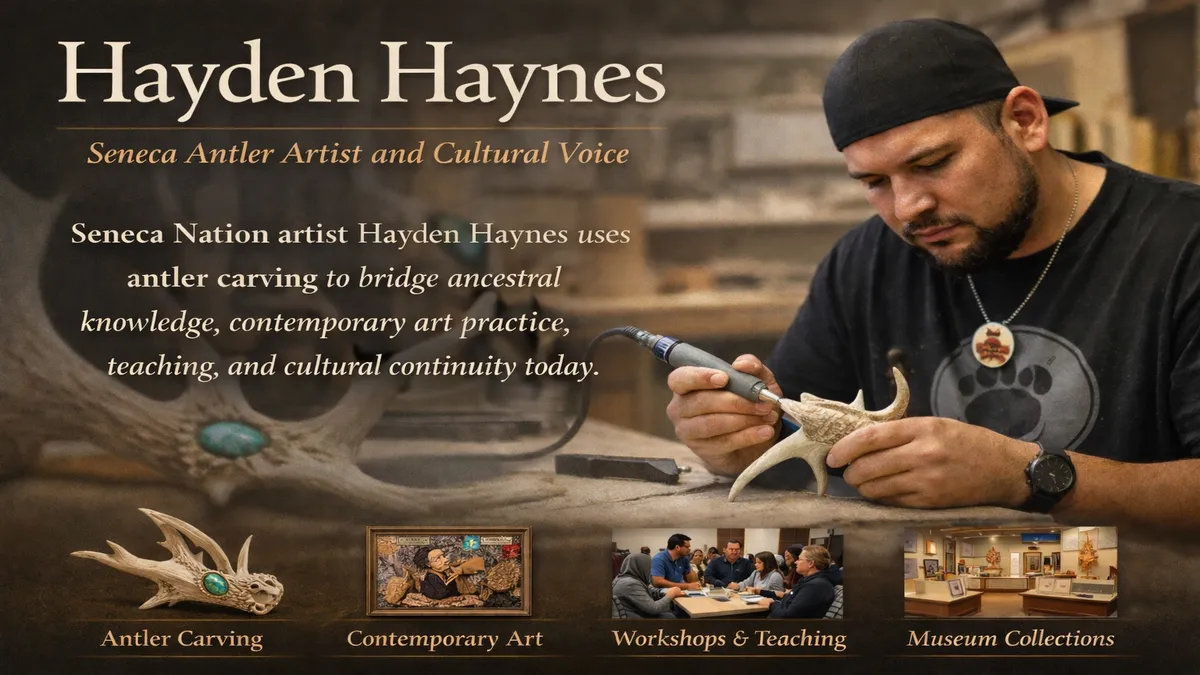
In an art world often driven by spectacle, novelty, and rapid cycles of attention, Hayden Haynes occupies a markedly different space. His work does not seek urgency through volume or provocation; instead, it insists on presence through material, memory, and continuity. Hayden Haynes is a Seneca Nation artist, antler carver, photographer, and mixed-media practitioner whose work situates Indigenous knowledge firmly in the present tense. Within the first moments of encountering his carvings, viewers confront not an artifact of the past, but a living articulation of Haudenosaunee worldview, carried forward through disciplined craft and contemporary artistic language.
Haynes’s practice answers a clear cultural and artistic need. Indigenous art has long been confined to anthropological frames or separated from the discourse of contemporary fine art. His work directly challenges that division. Through antler—an organic material deeply embedded in Haudenosaunee lifeways—he constructs objects that speak simultaneously to ancestry, land stewardship, and modern Indigenous identity. The carvings are intimate in scale yet expansive in meaning, demanding slow looking and contextual awareness.
Born in Claremore, Oklahoma, and raised on the Seneca-Cattaraugus Territory in Western New York, Haynes developed his artistic sensibility within a community where cultural continuity was lived rather than abstract. Over time, his practice expanded into museum collections, academic exhibitions, and teaching roles, all without relinquishing cultural accountability. His career reflects a broader movement within Indigenous art: one that asserts sovereignty not only politically, but aesthetically and intellectually.
From Clan Lineage to Carved Form
Hayden Haynes is a member of the Seneca Nation’s Deer Clan, a lineage that carries social, ceremonial, and cultural responsibilities. This belonging is not symbolic in his work; it is structural. Clan systems inform relationships to land, animals, and materials, and these relationships shape how antler functions within his practice. Antler is not extracted as a neutral medium. It is engaged with respect, awareness, and cultural memory, reinforcing a worldview in which materials are relational rather than inert.
Haynes’s introduction to carving began modestly. A gifted rotary tool from a family member became an entry point into experimentation, allowing him to explore form through tactile engagement rather than formal academic instruction. Early exposure to museum collections and Indigenous master carvers provided reference points, but his development remained rooted in observation, repetition, and self-directed refinement. Over time, he adopted more specialized equipment and techniques, expanding both precision and conceptual range.
What distinguishes Haynes’s work is not technical virtuosity alone, but intentional evolution. Traditional antler carving often emphasized utility or ceremonial purpose. Haynes retains those foundations while extending them into sculptural and conceptual territory. His carvings incorporate relief, negative space, and subtle narrative elements that invite interpretation without diluting cultural specificity. The resulting works function as contemporary art objects while remaining firmly anchored in Haudenosaunee values.
Material as Memory and Responsibility
Antler carries layered meaning within Indigenous cultures. It signifies regeneration, seasonal cycles, and the interdependence between humans and animals. In Haynes’s hands, these associations are neither romanticized nor abstracted. Instead, they are activated. Each carving becomes a site where memory, ecology, and identity converge.
Haynes frequently speaks of healing as a central theme in his work. This healing is not limited to personal expression. It extends to cultural restoration, intergenerational dialogue, and the reassertion of Indigenous presence in spaces that historically excluded it. His pieces resist being read as nostalgic gestures. They are contemporary statements that acknowledge historical rupture while emphasizing continuity.
The physicality of antler demands patience. Its density resists haste, forcing the carver into a deliberate rhythm. This slowness becomes part of the work’s meaning. In an era of accelerated production, Haynes’s process asserts that cultural knowledge cannot be rushed without consequence. The material itself enforces discipline, reflection, and accountability, aligning process with worldview.
Institutions and the Shift in Recognition
Hayden Haynes’s work has entered a range of institutional collections, marking a significant shift in how Indigenous carving is valued and contextualized. Museums that once relegated Native objects to ethnographic departments now present his work within contemporary art frameworks. This repositioning is not merely symbolic; it alters how audiences engage with Indigenous creativity.
Selected institutions holding his work include the Seneca-Iroquois National Museum, the Iroquois Indian Museum, the New York State Museum, the Museum of Fine Arts in Boston, and the Herbert F. Johnson Museum of Art. Each placement situates his carvings within different interpretive environments, from community-centered cultural spaces to major fine art institutions.
These acquisitions signal broader institutional reckoning. Haynes’s work challenges curatorial habits that separate “craft” from “art” and Indigenous production from modern discourse. By occupying these spaces, his carvings assert that Indigenous knowledge systems are not historical footnotes but active contributors to contemporary cultural thought.
Antler Carving in Transition
| Aspect | Traditional Context | Hayden Haynes’s Practice |
|---|---|---|
| Purpose | Tools, adornment, ceremony | Sculptural and conceptual art |
| Teaching | Informal community transmission | Workshops, residencies, public education |
| Symbolism | Clan, animal relations | Expanded narratives of identity and healing |
| Exhibition | Cultural settings | Museums and contemporary galleries |
This transition does not represent departure from tradition. Rather, it demonstrates adaptability. Haynes’s work shows how ancestral practices evolve without losing integrity. His carvings exist in dialogue with the past, not in imitation of it.
Teaching as Cultural Continuity
Education occupies a central role in Haynes’s career. As a teaching artist, he leads workshops and residencies that emphasize both technique and cultural context. These sessions are not limited to skill acquisition. Participants are introduced to the cultural responsibilities that accompany material use, reinforcing that art-making carries ethical dimensions.
For Indigenous youth, his presence offers representation and possibility. He demonstrates that cultural practices can sustain contemporary livelihoods without commodifying identity. For non-Indigenous learners, his teaching disrupts stereotypes by framing Indigenous art as intellectual, dynamic, and current.
This pedagogical work extends Haynes’s impact beyond objects. It cultivates future practitioners, informed audiences, and institutional partners capable of engaging Indigenous art with respect and depth. Teaching, for Haynes, is not secondary to making; it is an extension of cultural stewardship.
Collections and Cultural Context
| Institution | Location | Cultural Role |
|---|---|---|
| Seneca-Iroquois National Museum | Salamanca, NY | Community heritage preservation |
| Iroquois Indian Museum | Howes Cave, NY | Indigenous art education |
| New York State Museum | Albany, NY | State historical narrative |
| Museum of Fine Arts | Boston, MA | National fine art discourse |
| Herbert F. Johnson Museum | Ithaca, NY | Academic and curatorial research |
These placements reinforce the dual nature of Haynes’s work: culturally specific and broadly resonant.
Voice, Intention, and Vision
Haynes consistently articulates his work as an expression of Hodinöhsö:ni’ life today. His carvings address where Indigenous communities come from, where they exist now, and where they are moving. This temporal layering prevents static interpretation. Viewers are asked to consider Indigenous futures alongside Indigenous histories.
He continues to expand formal boundaries, incorporating color, layered surfaces, and mixed media elements that challenge expectations of antler carving. These innovations do not obscure tradition; they reveal its flexibility. By refusing to freeze Indigenous aesthetics in time, Haynes asserts creative sovereignty.
His practice also confronts systems that historically marginalized Indigenous voices. By occupying contemporary art spaces on his own terms, Haynes shifts power dynamics, insisting that Indigenous artists define their own narratives rather than perform externally imposed identities.
Takeaways
- Hayden Haynes positions Indigenous antler carving within contemporary fine art discourse
- His work emphasizes healing, continuity, and cultural responsibility
- Institutional collections reflect changing attitudes toward Indigenous art
- Teaching and community engagement are central to his practice
- Antler functions as both material and cultural language
- His career models sustainable, culturally grounded artistic pathways
Conclusion
Hayden Haynes represents a generation of Indigenous artists redefining how tradition lives in the present. His antler carvings do not seek validation through trend or spectacle. Instead, they command attention through depth, intention, and cultural clarity. By grounding contemporary form in ancestral knowledge, he demonstrates that Indigenous art is neither static nor peripheral.
His work reshapes institutional relationships, educational practices, and public understanding of Indigenous creativity. More importantly, it reinforces cultural continuity within his own community, offering both reflection and possibility. In a world eager for novelty, Haynes offers something more enduring: art that remembers, insists, and endures.
FAQs
Who is Hayden Haynes?
A Seneca Nation artist known for contemporary antler carving and mixed-media work grounded in Haudenosaunee culture.
What materials does he use most often?
Primarily antler, sometimes combined with mixed media and sculptural techniques.
Why is his work considered contemporary?
It addresses present-day Indigenous identity while using innovative forms and exhibition contexts.
Does Hayden Haynes teach?
Yes, he leads workshops and residencies focused on technique, culture, and material responsibility.
Where can his work be seen?
In museum collections, cultural institutions, and contemporary art exhibitions.