
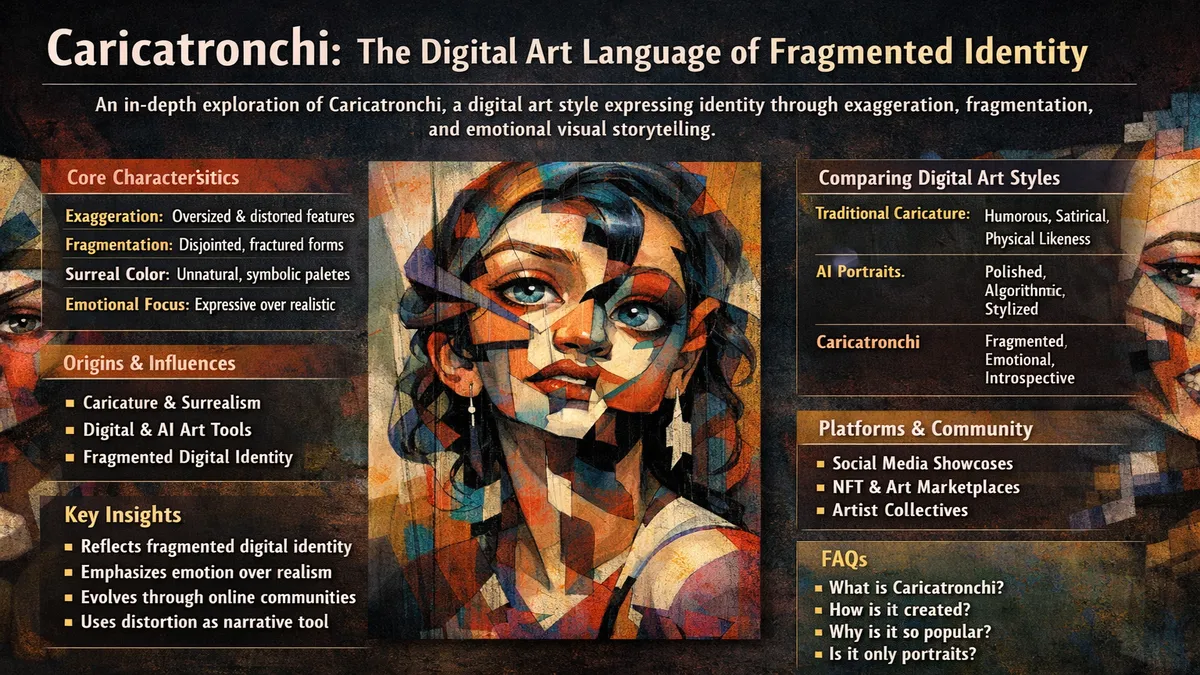
Caricatronchi is not a meme, a gimmick, or a passing visual trick. It is a developing digital art language that reflects how people now experience identity, emotion, and self-representation in an online-first world. Within contemporary digital spaces, Caricatronchi has emerged as a recognizable visual approach defined by exaggerated forms, fragmented anatomy, and emotionally charged distortion. In its simplest sense, it fuses caricature’s expressive exaggeration with surreal fragmentation to communicate inner realities rather than surface likeness.
In the first moments of encountering Caricatronchi artwork, viewers often feel a mix of familiarity and unease. Faces are recognizable yet broken apart. Bodies are human yet reassembled. Proportions stretch beyond realism, not for comedy alone, but to suggest tension, vulnerability, or psychological depth. This style resonates strongly in a time when identity itself feels divided across platforms, personas, and digital environments.
Caricatronchi developed alongside the rapid rise of digital illustration tools and AI-assisted creative systems in the early 2020s. These technologies enabled artists to manipulate form, scale, and texture with unprecedented freedom. But the movement’s power lies less in software than in intention. Artists use distortion as language, fragmentation as metaphor, and exaggeration as emotional signal.
Rather than aiming for polished beauty or photorealism, Caricatronchi embraces imperfection and imbalance. It reflects the modern condition: constantly observed, endlessly edited, and internally complex. As a result, Caricatronchi has become a visual shorthand for expressing identity in flux, offering artists and audiences a mirror that feels closer to lived experience than idealized imagery ever could.
Defining Caricatronchi as a Visual Language
Caricatronchi can be understood as a hybrid form that stands between caricature, surrealism, and digital expressionism. Traditional caricature exaggerates physical traits to reveal personality or social critique. Caricatronchi extends this idea inward, exaggerating emotional states, internal conflicts, and psychological fragmentation rather than outward appearance alone.
The term itself suggests fragmentation and construction. In practice, this appears through split facial planes, elongated limbs, oversized eyes, compressed torsos, or floating anatomical elements. These choices are rarely random. Artists use them to encode meaning: an enlarged eye may represent hyper-awareness or anxiety, while a fractured jaw might symbolize silenced expression.
Unlike classical caricature, which often relies on humor or satire, Caricatronchi frequently carries a serious or introspective tone. The distortion is expressive rather than mocking. It invites empathy instead of laughter, reflection instead of ridicule. Viewers are encouraged to read emotion through form, color, and spatial tension.
Caricatronchi is also deeply tied to digital aesthetics. Clean vector edges may coexist with glitch textures. Hand-drawn lines blend with algorithmic smoothness. This hybrid quality mirrors the contemporary self, shaped by both organic experience and technological mediation.
Historical and Cultural Roots
While Caricatronchi feels distinctly modern, its roots stretch across art history. Expressionist painters distorted the human body to convey emotion. Surrealists fragmented reality to explore the subconscious. Political cartoonists exaggerated features to critique power. Caricatronchi inherits from all of these traditions while translating them into a digital vernacular.
What differentiates Caricatronchi is context. It arises in a time when identity is continuously performed online. Profile pictures, avatars, filters, and AI-generated portraits have transformed how people see themselves and others. In this environment, fragmentation becomes not just an artistic choice but a lived reality.
Digital culture has normalized visual manipulation. Faces are edited, bodies reshaped, and realities curated. Caricatronchi responds by making that manipulation visible and intentional. Instead of hiding distortion, it amplifies it. Instead of smoothing imperfections, it sharpens them.
This openness gives Caricatronchi cultural relevance. It speaks to a generation comfortable with visual abstraction but hungry for authenticity. The art does not promise wholeness. It acknowledges complexity.
Tools, Technology, and Process
Caricatronchi is inseparable from digital tools, though it is not defined by any single platform. Artists typically begin with a sketch, either on paper or digitally, establishing a loose structure rather than a finished form. From there, they exaggerate, break apart, and rebuild.
Digital illustration software allows for rapid experimentation. Layers can be duplicated, distorted, erased, and recombined. AI-assisted tools sometimes introduce unexpected forms, which artists then refine or reinterpret. This collaborative tension between human intention and machine suggestion is central to the Caricatronchi process.
Color plays a crucial role. Unnatural palettes often replace realistic tones, signaling emotional states rather than physical accuracy. Lighting may be flat or intentionally inconsistent, reinforcing the sense of dislocation.
Despite its digital nature, Caricatronchi remains deeply personal. Artists often describe the process as introspective, even therapeutic. The act of fragmenting and reconstructing a figure becomes a way to process identity, emotion, or personal narrative.
Core Characteristics of Caricatronchi
| Element | Visual Expression | Conceptual Meaning |
|---|---|---|
| Exaggeration | Oversized or compressed features | Emotional emphasis |
| Fragmentation | Disconnected or split anatomy | Inner conflict or multiplicity |
| Surreal Color | Non-natural palettes | Mood and symbolism |
| Digital Hybridization | Mixed hand-drawn and algorithmic forms | Human-machine identity |
| Expressive Focus | Emotion over likeness | Psychological truth |
These characteristics combine to form a recognizable yet flexible visual language. No two Caricatronchi works look the same, but they share an underlying logic of expressive distortion.
Platforms and Community Growth
Caricatronchi thrives in online ecosystems where visual impact matters. Image-centric platforms allow artists to share work instantly, while short-form video spaces showcase process and transformation. Community forums and group chats provide critique, collaboration, and shared experimentation.
The movement grows horizontally rather than hierarchically. There is no central authority or official definition. Instead, shared aesthetics emerge through repetition, remixing, and dialogue. Artists influence one another through exposure rather than instruction.
This decentralized growth allows Caricatronchi to evolve rapidly. Styles shift, techniques adapt, and new visual motifs appear without formal declarations. The community itself becomes the engine of innovation.
Comparative Context Within Digital Art
| Style | Primary Focus | Emotional Tone | Relationship to Reality |
|---|---|---|---|
| Traditional Caricature | Physical likeness | Satirical | Exaggerated realism |
| Surreal Portraiture | Subconscious imagery | Dreamlike | Symbolic abstraction |
| AI Portrait Art | Visual novelty | Neutral to stylized | Algorithmic synthesis |
| Caricatronchi | Emotional identity | Introspective | Expressive distortion |
This comparison highlights Caricatronchi’s unique position. It is less about spectacle than meaning, less about accuracy than honesty.
Expert Perspectives on Meaning and Impact
Visual culture scholars have noted that Caricatronchi aligns closely with contemporary theories of fragmented identity. The style visualizes what many experience psychologically: the sense of being multiple, incomplete, and constantly redefined.
Digital curators emphasize its relevance in a post-filter era. As audiences become more visually literate, they are drawn to imagery that acknowledges manipulation rather than concealing it. Caricatronchi satisfies that desire by turning distortion into narrative.
Practicing artists often describe the style as liberating. Freed from the pressure of realism, they can prioritize feeling over form. This shift changes not only what is created but why it is created.
Cultural Significance and Longevity
Caricatronchi’s significance lies in its timing. It arrives during a period of technological acceleration, identity negotiation, and emotional visibility. The art does not claim to resolve these tensions. It gives them shape.
Whether Caricatronchi becomes a formally recognized movement or remains a fluid digital language is less important than its function. It offers a way to see oneself honestly in a visually saturated world.
As long as digital identity remains fragmented, Caricatronchi will remain relevant.
Takeaways
- Caricatronchi is a digital art language built on expressive exaggeration and fragmentation
- It prioritizes emotional truth over physical accuracy
- The style reflects contemporary experiences of digital identity
- Technology enables the form, but intention defines it
- Community participation drives its evolution
- Distortion functions as narrative, not decoration
Conclusion
Caricatronchi represents a shift in how visual culture understands identity. Rather than presenting the self as a finished product, it acknowledges incompleteness, contradiction, and emotional depth. Through exaggerated forms and fragmented structures, the style communicates what polished images often conceal.
In a digital environment saturated with filters and perfection, Caricatronchi feels honest. It does not promise clarity or cohesion. Instead, it offers recognition. Viewers see themselves not as idealized avatars but as complex, evolving beings shaped by both inner emotion and external systems.
As tools continue to advance and visual literacy grows, Caricatronchi is likely to expand rather than disappear. Its flexibility allows it to adapt, while its emotional core keeps it grounded. In that balance between distortion and truth, Caricatronchi finds its power.
FAQs
What is Caricatronchi?
Caricatronchi is a digital art style that blends caricature, surrealism, and fragmentation to express emotional and psychological identity.
Is Caricatronchi humorous or serious?
It can be both, but it often leans toward introspection rather than satire.
Do artists need AI tools to create Caricatronchi?
No. While AI can assist, the style can be created with standard digital or traditional drawing methods.
Why is fragmentation so common in this style?
Fragmentation symbolizes complex, layered, or divided identity in digital life.
Is Caricatronchi limited to portraits?
Portraits are common, but the style can extend to full figures, abstract forms, and conceptual compositions.