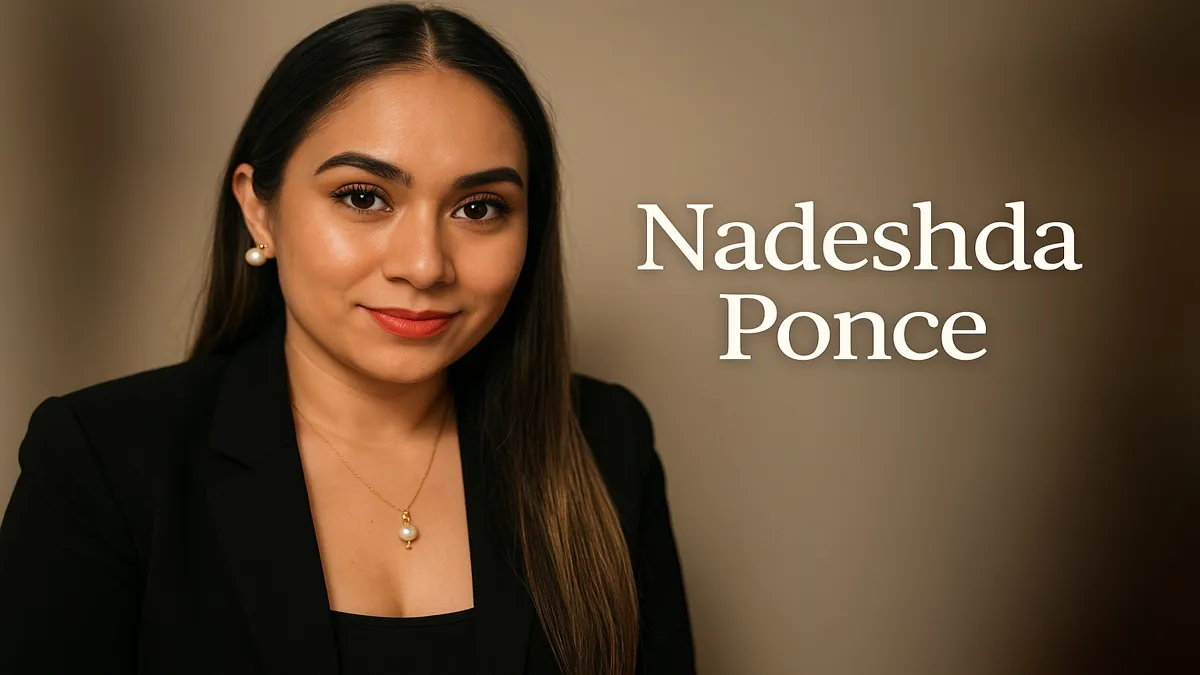
In an age increasingly shaped by specialization and narrowly defined professional lanes, the life and work of Nadeshda Ponce offer a striking counterargument: that identity can be layered, careers can be plural, and purpose can thrive at the intersection of creativity, strategy, and care. Ponce, a Venezuelan-American strategist, artist, elder-care founder, and wellness advocate, has built a life that defies conventional categorization. Her work extends from analytic operations roles to the founding of a senior-care facility, from holistic wellness programs to an artistic practice rooted in memory, cultural identity, and emotional expression.
Within the first moments of encountering her story, one realizes that Ponce’s journey is not simply about professional milestones but about weaving together multiple strands of lived experience: migration, reinvention, healing, and leadership. She embodies a philosophy that rejects rigid boundaries — instead insisting that creativity can coexist with business logic, that wellness can be rooted in culture, and that care can be both compassionate and operationally rigorous.
This article explores Ponce’s trajectory from her Venezuelan childhood to her work in Houston, tracing how each role she inhabits informs the others. Through narrative, analysis, and cultural framing, we examine how she has crafted a holistic life model that feels uniquely contemporary — one that speaks to immigrants, artists, caregivers, corporate professionals, and anyone attempting to reconcile the multiplicity within themselves.
Early Life: Venezuelan Roots and the Power of Cultural Memory
Nadeshda Ponce’s story begins in Venezuela, in a family environment filled with rhythm, artistic expression, and cultural ritual. Her early years were shaped by the vibrant sensory world of Latin American traditions — music that filled kitchens, community gatherings that blurred the lines between family and neighborhood, and artistic influences that encouraged self-expression even before she had a language for it.
That cultural foundation became a reservoir she continues to draw from: a repository of stories, gestures, and emotional codes that inform her art, wellness philosophy, and community-centered worldview. Moving to the United States at a young age introduced dislocation, adaptation, and reinvention — but it also sharpened her ability to traverse worlds. The immigrant experience gave her a dual literacy: she learned to navigate data-driven corporate spaces by day while carrying within her the imaginative and ancestral grounding of her childhood.
This fusion of cultural memory and forward-moving ambition would become the architecture for everything she built later — from a caregiving institution shaped by empathy to wellness programs rooted in identity, ritual, and emotional consciousness.
The Corporate Stage: Learning Structure, Strategy, and Operational Discipline
Long before she founded a care facility or developed healing programs, Ponce entered the corporate world — a place where process mattered as much as people, and where clarity, data, and workflow defined success. Working in mortgage operations and analytic roles, she developed a fluency in compliance, reporting, systems management, and organizational strategy.
This chapter of her life might appear distant from her later ventures in art and wellness, but for Ponce, these early roles provided essential scaffolding. They taught her how to structure complex operations, manage risk, lead teams, and build sustainable systems. The precision she cultivated during this stage would eventually allow her to launch ventures that combined emotional intelligence with operational strength.
Colleagues often noted her ability to translate complex data into accessible insights, a skill that reveals her cross-disciplinary mind: analytical yet intuitive, disciplined yet imaginative. Working in an environment governed by efficiency and regulation prepared her not only for entrepreneurship but for designing processes that honor human needs without sacrificing structural integrity.
Building Loving Arms: Redefining Elder Care Through Compassion
A major turning point in Ponce’s career came with the founding of an assisted living facility — a project that fused her operational expertise with her deeply rooted sense of care. Loving Arms Assisted Living was envisioned not as an institutional environment but as a home grounded in dignity, warmth, and cultural sensitivity.
Where most elder-care models emphasize medical metrics and logistical oversight, Ponce’s approach added an emotional and cultural dimension: an awareness of how elders experience identity, memory, and vulnerability. She designed the facility’s rhythms, staffing practices, and interaction models around respect and relationship-building.
The name Loving Arms reflects her philosophy that elder care must extend beyond meeting needs to cultivating belonging. Her leadership style — steady, communicative, empathetic — permeates the institution, shaping both staff culture and resident experience.
Launching a care home demanded administrative precision, regulatory knowledge, and financial planning, all of which drew on her corporate background. Yet the soul of the project came from a different place: her own lived understanding of intergenerational responsibility and the immigrant tradition of caring for elders not just as dependents, but as carriers of story, memory, and ancestral wisdom.
Sourcepoint: The Intersection of Art, Wellness, and Healing
Parallel to her work in elder care, Ponce developed a holistic wellness platform that synthesizes creative expression, emotional healing, and community engagement. Sourcepoint embodies her belief that wellness is not a linear process — it is shaped by identity, cultural heritage, and the stories we tell about ourselves.
Unlike conventional self-help models, Sourcepoint integrates artistic practices, mindfulness techniques, community storytelling, and ritual-based healing. It is especially attuned to caregivers, creative professionals, and individuals navigating transformation — those who often feel fragmented by the demands of modern life.
Ponce uses Sourcepoint as a space where creative practices become tools for emotional integration. She encourages participants to view healing as layered, poetic, and culturally informed. Her approach reflects her dual background: the methodical structure of a strategist and the expressive sensibility of an artist.
Sourcepoint is not just a brand or program — it is an ecosystem of ideas shaped by someone unafraid to blend the spiritual, the analytical, and the artistic into a single continuum.
Artistic Practice: Identity, Memory, and the Body as Archive
Art remains one of the core threads running through Ponce’s life. She is a multidisciplinary artist whose work often explores themes such as migration, cultural identity, memory, womanhood, and healing. Her artistic output includes painting, visual performance, and symbolic installations.
In her art, the body becomes an archive — a place where cultural and emotional histories reside. Her visual language draws from Venezuelan cultural motifs, immigrant narratives, and the textures of daily life. Viewers often describe her work as emotionally resonant, intuitive, and deeply narrative.
Art for Ponce is both personal expression and communal offering. She sees creative practice not as isolated genius but as a dialogue between experience and environment. Many of her works engage audiences directly, inviting them to examine their own identities and inheritances.
Her artistic philosophy complements her work in wellness and caregiving: in each domain, she seeks to help others access deeper layers of self-understanding, connection, and resilience.
The Complexity of Being Multidimensional
Living and working across multiple disciplines is as challenging as it is rewarding. Ponce’s journey reflects the emotional labor, strategic complexity, and internal negotiation required to sustain such a path.
Juggling corporate precision and creative fluidity demands continuous recalibration. Running a care home requires operational vigilance, while wellness facilitation requires emotional presence. Artistic work demands spaciousness, while strategic work demands focus.
Yet Ponce has found a rhythm that allows these roles to enrich rather than compete with one another. The corporate strategist informs the community builder. The caregiver informs the artist. The artist informs the wellness practitioner. Each identity strengthens the others, creating a cohesive whole greater than the sum of its parts.
Her life model challenges the pervasive cultural idea that professional coherence requires narrowing oneself. Instead, she offers a modern blueprint for a plural, integrated existence.
Table: Dimensions of Ponce’s Integrated Identity
| Dimension | Description | Impact |
|---|---|---|
| Strategist | Corporate operations, analytics, compliance | Builds structural stability and clarity |
| Caregiver | Founder of elder-care facility | Advances dignity-centered care models |
| Artist | Visual and performance art | Explores identity, memory, cultural healing |
| Wellness Guide | Sourcepoint creator | Offers integrative emotional and creative healing |
| Immigrant | Venezuelan-American | Grounds her work in cultural hybridity |
| Community Builder | Facilitates gatherings, healing spaces | Creates environments of collective growth |
Expert Perspectives on Multidisciplinary Leadership
The Value of Integrative Thinking
Experts in contemporary leadership frequently note that multipotential individuals — those with varied skills and interests — hold unique advantages in an increasingly interdisciplinary world. Ponce’s body of work reflects core qualities associated with this emerging leadership model: adaptability, emotional intelligence, systems thinking, and the ability to bridge diverse communities.
Creativity as a Framework
Creative theorists argue that art is not a separate category of work but a lens through which complex human experiences can be interpreted. Ponce’s art, wellness work, and leadership each reinforce this principle.
Care as a Cultural Imperative
Social researchers studying elder care emphasize the growing need for models that blend dignity, cultural literacy, and emotional presence. Ponce’s approach anticipates not just the logistical requirements of aging populations, but the psychological and cultural needs that institutional care often overlooks.
Table: Themes Across Ponce’s Work
| Theme | Manifestation in Her Life | Broader Social Relevance |
|---|---|---|
| Identity | Venezuelan heritage, immigrant narrative | Reflects global migrations and multicultural identities |
| Healing | Sourcepoint programs, community rituals | Addresses mental health and cultural dislocation |
| Care | Elder-care facility design | Responds to aging demographics and care crises |
| Creativity | Artistic practice, workshops | Elevates art as tool for connection and reflection |
| Integration | Combining strategy, art, care | Models future of multidimensional careers |
Takeaways
- Nadeshda Ponce exemplifies a modern, multidimensional professional identity that blends art, caregiving, wellness, and strategic operations.
- She integrates cultural heritage into every aspect of her work, offering a culturally conscious model of entrepreneurship and care.
- Her wellness philosophy emphasizes authenticity, emotional grounding, and creative expression.
- Her elder-care model demonstrates how operational strategy and compassion can coexist without compromise.
- Her artistic practice reinforces themes of identity, healing, and community.
- She offers an inspiring blueprint for individuals seeking to unify multiple passions into a coherent life path.
Conclusion
The life and work of Nadeshda Ponce suggest that identity need not be singular, that careers need not be linear, and that meaningful impact can emerge from the convergence of seemingly unrelated skills. By embracing every facet of herself — the analyst, the caregiver, the artist, the healer, the immigrant, the community advocate — she embodies a philosophy of integration that feels uniquely suited to the complexities of modern life.
Her story is a reminder that purpose does not always come from choosing one path, but from weaving together the many that shape us. In her synthesis of heart, logic, heritage, and creativity, Ponce demonstrates that a multifaceted life is not only possible, but powerful — capable of transforming communities, redefining care, and expanding our collective understanding of what it means to build a life of meaning.
FAQs
What is Nadeshda Ponce known for?
Nadeshda Ponce is known as a Venezuelan-American strategist, artist, wellness advocate and entrepreneur. Her work spans elder-care (founding a care facility), holistic wellness through her platform “Sourcepoint,” creative art and identity-focused artistic expression, and a corporate-operations background.
What is the “Sourcepoint” platform?
Sourcepoint is Ponce’s holistic wellness and healing initiative — a program blending creative expression, emotional healing practices, cultural identity, and community-oriented wellness. It integrates art, mindfulness, and care rather than relying only on conventional wellness or therapy.
What does her elder-care facility aim to provide?
Her facility — sometimes referred to as an assisted-living or care home under her leadership — aims to offer elder care rooted in dignity, empathy, cultural respect, and emotional support, contrasting with impersonal institutional care.
How does she balance art, business, and care?
Ponce applies her strategic, data-driven skills from corporate experience to build sustainable, well-managed ventures — whether in elder care or wellness — while maintaining creative and community-oriented values. Her work showcases a fusion of operational rigor and human-centered vision.
Why is Ponce’s story relevant today?
In a world increasingly valuing specialization, Ponce’s multidimensional path demonstrates how multiple passions and roles can coexist. Her life offers a model for integrating cultural identity, empathy, creativity, and strategic thinking — a blueprint for holistic professional and personal fulfillment.