
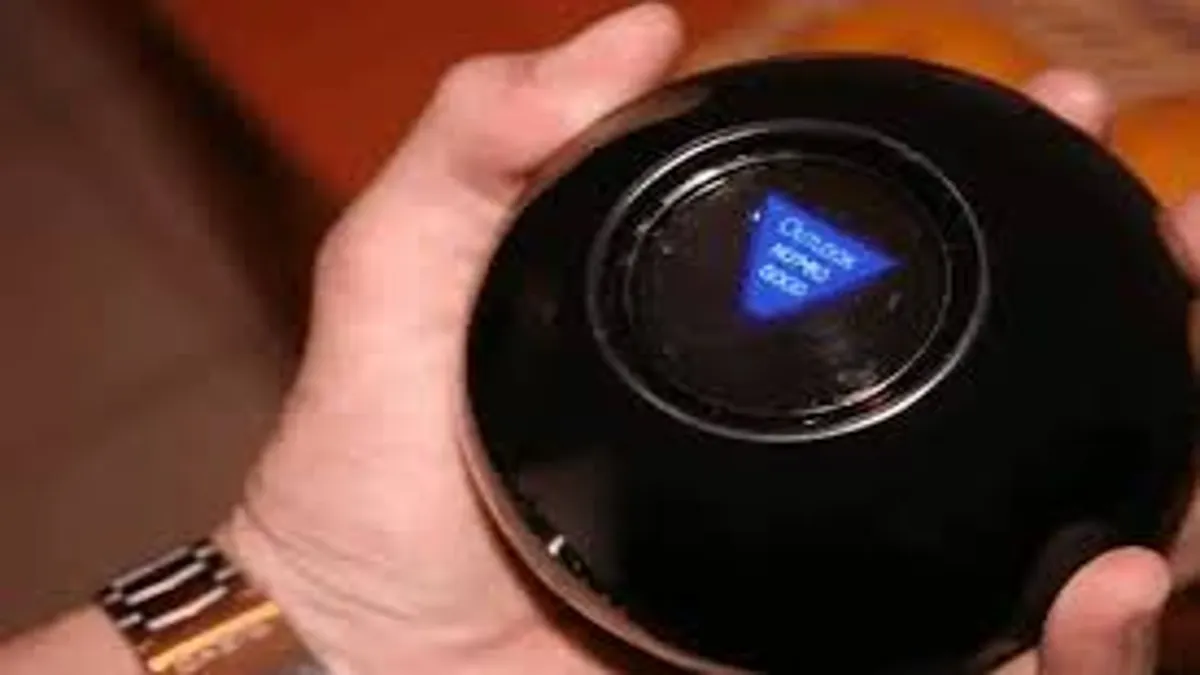
The Magic 8 Ball has long served as a playful arbiter of fate, capable of delivering twenty possible answers to countless questions across generations. In the first 100 words of exploring its mechanism, what feels mystical is actually grounded in purposeful design: a floating, twenty-sided die; a liquid-filled chamber; and a viewport that reveals whichever face drifts upward. The Magic 8 Ball’s ability to offer so many answers is neither supernatural nor digitally programmed; rather, it reflects physical randomness shaped by fluid dynamics and a simplicity that has endured for decades.
Its history stretches back to mid-20th-century fortune-telling devices, eventually evolving into the familiar billiard-ball form. Yet its longevity comes from more than novelty. The ball’s ritual — ask, flip, wait — is comforting, tactile, and universal. Its answers, distributed across yes, no, and uncertain categories, are ambiguous enough to apply to almost anything, making each result feel personally meaningful. The Magic 8 Ball’s remains a cultural artifact precisely because it blends randomness with emotional projection, transforming a simple mechanism into a playful instrument of possibility.
Origins: A Journey from Fortune Device to Cultural Icon
The Ma-gic 8 Ball traces its lineage to the Syco-Seer and Syco-Slate, cylindrical fortune-telling devices introduced in the 1940s. Their mechanism relied on a floating die inside a liquid-filled chamber, visible through small windows. Inventor Albert C. Carter and his brother-in-law, manufacturer Abe Bookman, refined the design into a more compact “pocket fortune-teller.” The transformation into the iconic billiard-ball silhouette arrived in 1950, when a billiards company commissioned a promotional model shaped like the familiar black eight ball.
Ownership of the product shifted over the decades, yet the core mechanism remained the same. Its endurance stems from its recognizable shape, accessible design, and the natural human attraction to small rituals that provide a momentary sense of guidance. By the late twentieth century, sales regularly surpassed a million units annually, demonstrating the toy’s status as both novelty and cultural touchstone.
Read: Understanding JEUDS and Europe’s Data-Driven University Future
Inside the Sphere: How the Mechanism Actually Works
At its core, the Magic 8’s Ball is a study in simplicity. Beneath its molded plastic shell lies an internal cylindrical chamber filled with dark blue liquid. Suspended in this liquid is a twenty-sided polyhedron — a regular icosahedron — each face embossed with one of the toy’s standard answers. When the ball is inverted, the die drifts upward and rests against a transparent window, displacing the liquid just enough to allow the raised letters to become visible as crisp white text against a blue background.
Because the die floats, not sinks, it remains freely mobile within the chamber. The viscosity of the liquid slows its motion, preventing sudden jolts and allowing the die to settle naturally into a face-up orientation. Although shaking is common, it is not recommended, as bubbles can obscure the answer. When used properly, each reading results from a gentle, naturally randomized process.
How Twenty Answers Became the Standard
The Magic 8 Ball’s twenty responses reflect a carefully balanced blend of affirmation, ambiguity, and denial. The breakdown is intentional:
| Category | Number of Responses | Representative Examples |
|---|---|---|
| Affirmative | 10 | “It is certain,” “Yes – definitely” |
| Neutral / Uncertain | 5 | “Reply hazy, try again” |
| Negative | 5 | “Don’t count on it,” “Very doubtful” |
This distribution skews positive but retains enough ambiguity to remain playful. Because none of the answers are highly specific, they can apply across an infinite range of questions. The design ensures results feel authoritative without forcing precision, which keeps the toy flexible, reusable, and psychologically engaging.
The Physics of Chance: Why the Answers Feel Meaningful
The Magic 8 Ball’s mechanism is not mystical; it is mechanical randomness. The floating die’s final position is determined by buoyancy, liquid drag, and the geometry of the icosahedron. Each inversion is effectively a “roll,” even though the die is contained within a sealed fluid chamber.
Randomness is only part of the appeal. Users bring expectations, hopes, and anxieties to each question they ask. The act of flipping the ball becomes a small ritual, and the mind naturally projects meaning onto whichever answer appears. The toy’s power lies not in prediction but in its capacity to mirror uncertainty in a way that feels personal.
One designer reflecting on the object described how people infuse it with personality, granting its random responses a semblance of authority. That emotional projection is where the ball’s charm lives — in the interplay between mechanical randomness and human imagination.
Why the Magic 8 Ball Still Feels Magical
Beyond its physical mechanics, the Magic 8 Ball’s succeeds because of its emotional clarity. It fits naturally in social settings, makes decisions feel momentarily lighter, and entertains without requiring explanation. Its ritualized motion — ask, flip, reveal — creates a narrative arc in seconds.
The toy’s simplicity also allows it to bridge generations. Children discover it as a game; adults return to it as nostalgia; groups use it as a bonding device or humorous decision maker. Complexity would undermine its appeal. Instead, its design has remained nearly unchanged because it already captures the perfect formula: structured randomness wrapped in cultural familiarity.
Comparison: Magic 8 Ball and Other Random-Answer Tools
| Feature | Magic 8 Ball | Digital Randomizers | Symbolic Systems |
|---|---|---|---|
| Medium | Physical, tactile | Software-based | Cards, runes, symbols |
| Number of Responses | Exactly 20 | Potentially unlimited | Dozens or more |
| Source of Randomness | Die + liquid physics | Algorithms | Human shuffle |
| Emotional Experience | Ritualized, playful | Instant, less tactile | Interpretive, symbolic |
| Accessibility | Universal, no power | Requires device | Requires learning |
This table shows that the Magic 8 Ball’s occupies a unique space: more tactile and personal than digital tools, simpler than symbolic systems, and more structured than improvisational methods.
Expert Perspectives on Its Enduring Appeal
“Its design reveals how randomness can feel authoritative when given a ritual and an object to inhabit.”
“People return to it not for certainty, but for the comfort of letting a simple mechanism temporarily decide for them.”
“Its answers endure because they are vague enough to apply to almost any situation, yet distinct enough to feel intentional.”
These reflections highlight how a toy anchored in physics continues to resonate through emotional and cultural pathways.
Takeaways
- The Magic 8 Ball’s delivers twenty answers through a floating, twenty-sided die suspended in blue liquid.
- Its answers are structured into affirmative, neutral, and negative groups, balancing clarity with ambiguity.
- Randomness arises from buoyancy and fluid dynamics, not mysticism.
- The ritual of asking and flipping gives emotional weight to each outcome.
- Its enduring popularity lies in simplicity, nostalgia, and universal applicability.
- The design has remained largely unchanged because it fulfills its purpose perfectly.
Conclusion
The Magic 8 Ball continues to fascinate because it blends mechanical simplicity with emotional resonance. Its ability to offer many answers comes from a precise combination of geometry, liquid behavior, and intuitive design, yet what users experience feels closer to magic than mechanics. Each flip provides not just a randomized answer but a moment of reflection — a chance for uncertainty to take shape in a brief phrase. In a world increasingly shaped by digital complexity, the Magic 8 Ball’s stands as a reminder that sometimes the most enduring tools are the simplest ones: a sphere, a ritual, and the human impulse to seek meaning.
FAQs
Why does the Magic 8 Ball give exactly twenty answers?
Because its internal die is a twenty-sided icosahedron, allowing twenty distinct faces that can each display a response.
Why are some answers positive and others negative?
The distribution balances encouragement with ambiguity and realism, allowing the toy to apply broadly to many questions.
Does shaking affect the result?
Yes. Shaking can create bubbles that obscure the answer, though it does not change the randomness of which face rises.
Is the Magic 8 Ball scientifically random?
Its randomness derives from fluid movement and geometry, producing outcomes similar to rolling a twenty-sided die.
Why do people keep using the Magic 8 Ball’s today?
Because its ritual is timeless, its answers are playful, and its ambiguity invites personal interpretation.
References
- Britannica. (n.d.). Where did the idea for the Magic 8 Ball come from? Retrieved from
https://www.britannica.com/story/where-did-the-idea-for-the-magic-8-ball-come-from - The Strong National Museum of Play. (n.d.). Magic 8 Ball. Retrieved from
https://www.museumofplay.org/toys/magic-8-ball/ - Mental Floss. (n.d.). A brief history of the Magic 8 Ball. Retrieved from
https://www.mentalfloss.com/article/67702/brief-history-magic-8-ball - Core77. (n.d.). Toy design history: How they came up with the Magic 8 Ball. Retrieved from
https://www.core77.com/posts/80897/Toy-Design-History-How-They-Came-Up-with-the-Magic-8-Ball - MagicTricks.com. (n.d.). All about the Magic 8 Ball. Retrieved from
https://www.magictricks.com/magic-8-ball-blog.html - TIME Magazine. (2011). Magic 8 Ball — All-TIME 100 Greatest Toys. Retrieved from
http://content.time.com/time/specials/packages/article/0,28804,2049243_2048651_2049037,00.html - Thumbs Up UK. (2024). The Magic 8 Ball explained: History, psychology & fun uses. Retrieved from
https://thumbsup.com/blogs/thumbs-up-blog/magic-8-ball-secrets-history-products - The Hustle. (2023). The history of the Magic 8 Ball. Retrieved from
https://thehustle.co/the-history-of-the-magic-8-ball - University of Cincinnati Magazine. (n.d.). Abe Bookman, creator of the Magic 8 Ball. Retrieved from
https://magazine.uc.edu/famousalumni/designers/magic8.html - Magic-8Ball.com. (n.d.). Magic 8 Ball answers list. Retrieved from
https://magic-8ball.com/magic-8-ball-answers/