
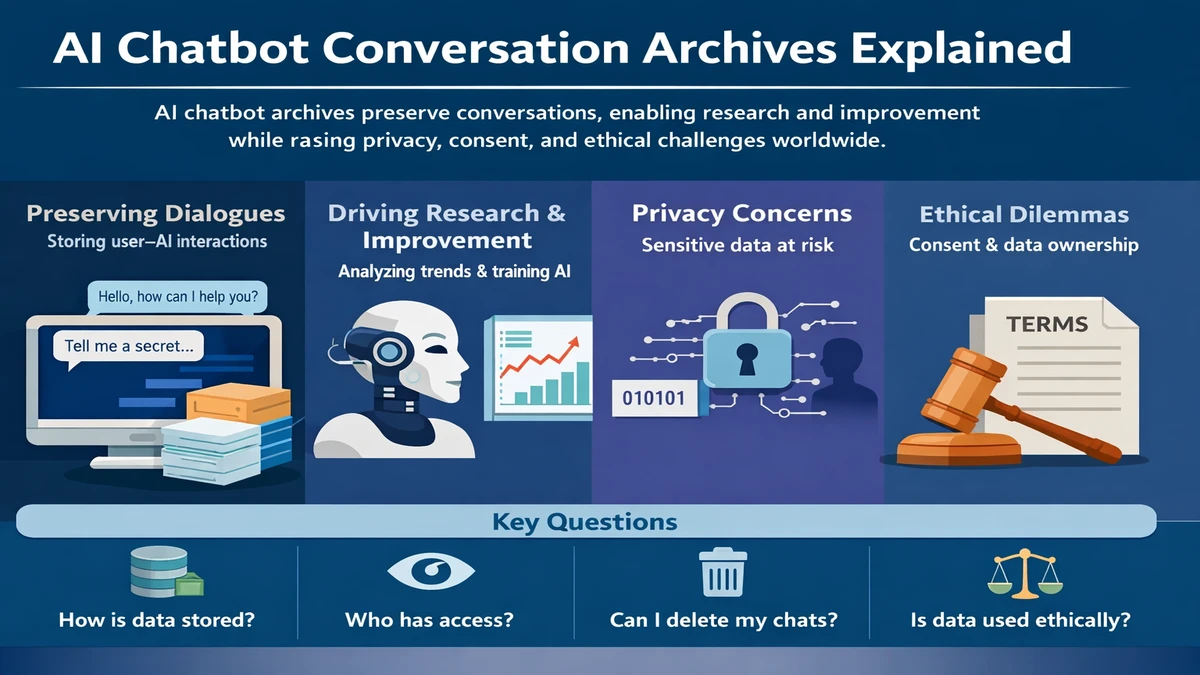
Every day, billions of words are exchanged between humans and artificial intelligence systems. These exchanges feel fleeting—typed, read, and forgotten within seconds. Yet behind the interfaces of AI chatbots lies a quieter reality: most conversations are archived. An AI chatbot conversations archive is the structured preservation of human–AI dialogue, stored not only as text but as data enriched with timestamps, contextual markers, and system metadata. In the first moments of any interaction, these archives already begin shaping the future of the technology itself.
For users, chatbot conversations often feel private, conversational, even intimate. People ask questions they might hesitate to ask another human. They brainstorm ideas, seek emotional reassurance, explore sensitive topics, or automate routine tasks. For developers, researchers, and organizations, these same conversations become invaluable datasets. They reveal how people communicate with machines, where systems fail, how language evolves, and what users actually want rather than what designers assume they want.
The tension between these perspectives defines the modern debate around chatbot archives. On one hand, archived conversations fuel improvements in accuracy, safety, and usability. On the other, they raise profound concerns about consent, privacy, memory, and ownership. Unlike traditional software logs, conversational archives capture human expression in its rawest digital form.
Understanding how AI chatbot conversation archives work—and why they matter—means looking beyond the interface. It requires examining technical systems, research practices, ethical frameworks, and the subtle psychological contract between humans and machines. This article explores how these archives emerged, how they are used, what risks they pose, and why they have become one of the most consequential yet least visible elements of the AI ecosystem.
The Origins of Chatbot Conversation Archiving
The practice of archiving chatbot conversations did not begin with modern large language models. Early rule-based chat systems logged interactions primarily for debugging. Developers needed to know why a system failed to recognize a command or returned an incorrect response. These logs were short, technical, and rarely stored long-term.
As conversational AI grew more sophisticated, logging evolved from a troubleshooting tool into a strategic asset. Machine learning systems rely on examples, and real conversations provided unmatched insight into language variability, intent ambiguity, and user expectations. Archiving became systematic. Conversations were indexed, categorized, and stored in databases designed to scale across millions or even billions of interactions.
Modern chatbot archives typically store multiple layers of information. Beyond the user’s message and the system’s reply, archives may include timestamps, language identifiers, moderation flags, error states, confidence scores, and anonymized user identifiers. This layered structure allows engineers to reconstruct not only what was said, but how the system arrived at its response.
Over time, archiving shifted from optional to foundational. Many AI platforms now treat conversation logs as a core component of system maintenance and improvement. The archive is no longer a byproduct of interaction; it is an integral part of how conversational AI learns, evolves, and is governed.
What Exactly Is an AI Chatbot Conversations Archive?
An AI chatbot conversations archive is a centralized repository that stores past interactions between users and AI systems in a structured, queryable format. It is not merely a chat history visible to a user but an internal dataset designed for analysis, compliance, and system development.
These archives are often divided into short-term and long-term storage. Recent conversations may be stored in high-speed environments for immediate debugging or quality monitoring. Older interactions are typically moved to long-term storage optimized for cost efficiency and large-scale analysis. This tiered approach allows organizations to balance performance with retention needs.
Archives can include both raw and processed data. Raw logs preserve the original dialogue, while processed versions may remove personally identifiable information, annotate intent, or label safety-related issues. In research contexts, archived conversations are sometimes aggregated into datasets that support linguistic analysis, behavioral studies, and cross-platform comparisons.
The defining characteristic of a chatbot archive is persistence. Conversations that feel ephemeral to users are preserved as durable records, capable of being revisited long after the interaction has ended. This persistence transforms casual exchanges into long-lasting digital artifacts.
Why Organizations Archive AI Conversations
The motivations behind archiving chatbot conversations are varied and overlapping. One of the primary reasons is system improvement. Archived dialogues help developers identify common failure modes, misunderstood queries, and unintended behaviors. Patterns observed across thousands of conversations can reveal subtle biases or gaps in knowledge that individual tests would miss.
Customer experience optimization is another driver. For businesses deploying chatbots in support roles, conversation archives reveal where users become frustrated, which questions recur most frequently, and where automated systems should hand off to humans. These insights directly inform product design and service strategy.
Compliance and accountability also play a role. In regulated industries, archived conversations provide an audit trail. They allow organizations to demonstrate adherence to policies, investigate complaints, and respond to legal inquiries. In this sense, chatbot archives function similarly to recorded customer service calls.
Research and innovation represent a third motivation. Large-scale conversational data enables the study of language use, human–AI interaction dynamics, and the social impact of automation. Without archives, such longitudinal and comparative research would be impossible.
Conversation Archives in Scientific Research
In academic contexts, archived chatbot conversations have become a powerful research resource. Scholars analyze these datasets to understand how people phrase questions, how conversational norms shift over time, and how AI responses influence user behavior. Unlike synthetic datasets, real-world conversation archives capture spontaneity, error, emotion, and cultural variation.
Researchers studying linguistics examine how users adapt their language when speaking to machines. Social scientists explore trust, dependency, and emotional attachment in prolonged human–AI interactions. Computer scientists use archived conversations to benchmark system performance and evaluate safety mechanisms.
One of the most significant developments has been the creation of multi-platform datasets that preserve conversations across different AI systems. These datasets allow researchers to compare how various models handle similar prompts, revealing differences in reasoning style, tone, and informational depth. Such comparisons deepen understanding of how design choices shape user experience.
At the same time, academic use of conversation archives has intensified ethical scrutiny. Researchers must navigate consent, anonymization, and the risk of re-identification, particularly when analyzing sensitive topics. As a result, many institutions now require strict data governance protocols before granting access to archived chatbot dialogues.
Privacy Risks Embedded in Archived Conversations
Privacy concerns sit at the center of the debate around AI chatbot conversation archives. Unlike traditional usage data, conversational logs often contain deeply personal information. Users may disclose health concerns, financial worries, relationship issues, or private thoughts, believing they are engaging in a private exchange.
Even when names and obvious identifiers are removed, contextual details can make conversations traceable. A unique combination of events, locations, or experiences described in a chat may be enough to identify an individual when cross-referenced with other data sources. This risk grows as archives become larger and more interconnected.
Long-term retention amplifies these concerns. Conversations stored indefinitely accumulate into detailed behavioral profiles. Over time, archived dialogues can reveal changes in beliefs, habits, emotional states, and life circumstances. Such longitudinal data is exceptionally sensitive.
Security vulnerabilities further complicate the picture. Any system that stores large volumes of conversational data becomes a potential target for breaches. Unauthorized access to chatbot archives could expose intimate human expression at scale, with consequences that extend far beyond traditional data leaks.
Consent and User Awareness
A critical issue surrounding chatbot conversation archives is informed consent. Many users are unaware that their interactions are stored, analyzed, or potentially used to improve AI systems. Disclosure is often buried in lengthy terms of service that few people read or fully understand.
The conversational nature of chatbots can create a false sense of ephemerality. Unlike emails or social media posts, chats feel transient. This perception clashes with the reality of persistent storage, creating a mismatch between user expectations and system behavior.
Some platforms offer opt-out mechanisms or data deletion tools, but these options are not always easy to find or fully comprehensive. In certain cases, conversations may be retained for legal or safety reasons even after a user requests deletion.
The question of consent is not merely legal but ethical. Meaningful consent requires clarity, accessibility, and genuine choice. As chatbot archives become more central to AI development, the adequacy of existing consent models is increasingly questioned.
Ownership of Human–AI Dialogue
Who owns a conversation between a human and an AI? This seemingly simple question has no universally accepted answer. From a technical perspective, organizations often claim ownership of archived conversations as part of their system data. From a human perspective, users may feel that their words—and the ideas expressed through them—belong to them.
This ambiguity becomes particularly complex when archived conversations are used for training or research. User-generated content contributes directly to system improvement, blurring the line between service use and unpaid labor. Some critics argue that users are effectively co-creating value without recognition or compensation.
Ownership debates also intersect with cultural and philosophical ideas about authorship, memory, and agency. Conversations are relational by nature. When one participant is an AI, traditional assumptions about dialogue ownership no longer neatly apply.
Ethical Dimensions of Emotional Data
Chatbot conversation archives frequently include emotional content. Users express fear, loneliness, excitement, anger, and vulnerability. These emotional traces are valuable for improving empathetic responses, but they also raise ethical concerns about emotional surveillance.
Analyzing emotional patterns at scale risks reducing complex human experiences to data points. There is a danger that emotional archives could be exploited for manipulation, targeted persuasion, or behavioral prediction. Even when intentions are benign, the power imbalance between users and platform operators remains significant.
Ethical frameworks increasingly emphasize the need to treat conversational data not merely as text, but as expressions of human interiority. This perspective calls for heightened care in how archives are accessed, analyzed, and retained.
Technical Safeguards and Data Governance
In response to growing concerns, many organizations are implementing technical safeguards to protect archived chatbot conversations. Encryption at rest and in transit is now standard practice. Access controls limit who can view raw conversation logs, often restricting them to small, audited teams.
Data minimization strategies aim to reduce risk by storing only what is necessary. Some systems automatically redact sensitive information or summarize conversations instead of preserving full transcripts. Others apply differential privacy techniques to obscure individual contributions while preserving aggregate insights.
Governance frameworks complement technical measures. Clear retention schedules, regular audits, and internal ethics reviews help ensure that conversation archives are managed responsibly. While no system is risk-free, these practices represent an evolving effort to balance utility with protection.
Comparing Uses of Chatbot Conversation Archives
| Context | Primary Purpose | Key Risks |
|---|---|---|
| Product development | Improve accuracy and usability | Over-retention of personal data |
| Customer support | Analyze service quality | Exposure of sensitive customer issues |
| Academic research | Study language and interaction | Consent and anonymization challenges |
| Compliance and auditing | Maintain accountability | Long-term storage of personal expression |
Timeline of Archive Evolution
| Period | Characteristic |
|---|---|
| Early chatbots | Minimal logging for debugging |
| Pre–deep learning era | Limited storage, technical focus |
| Large language model emergence | Large-scale, structured archives |
| Present day | Ethical, legal, and governance emphasis |
Expert Perspectives on Conversation Archiving
One data ethics scholar has noted that conversational archives represent “the most intimate form of behavioral data ever collected at scale,” emphasizing that language reveals intention and emotion in ways other data cannot.
A human–computer interaction researcher has argued that archived chats are redefining usability research by replacing lab simulations with lived digital experience, offering unprecedented realism but also unprecedented responsibility.
A privacy technologist has warned that without strict retention limits, chatbot archives risk becoming “permanent psychological records,” stressing that the ability to forget is as important for digital systems as it is for humans.
Takeaways
- AI chatbot conversation archives transform fleeting interactions into long-term digital records
- These archives are central to system improvement, research, and accountability
- Privacy risks increase with emotional depth and long-term retention
- Consent and ownership remain ethically unresolved issues
- Technical safeguards and governance frameworks are evolving but incomplete
- Conversation archives shape not only AI behavior but human trust in technology
Conclusion
AI chatbot conversation archives occupy a quiet yet powerful position in the digital ecosystem. They are the memory of conversational AI, preserving the words, questions, and emotions that define human interaction with machines. Without these archives, modern AI systems could not learn, adapt, or improve at the pace society expects. With them, however, come responsibilities that extend beyond engineering.
The challenge is not whether to archive conversations, but how. Transparency, restraint, and respect for human expression must guide retention practices. As chatbots become more embedded in daily life, the ethical management of their memories will shape public trust as much as technical performance. In deciding how these archives are built and governed, society is also deciding what kind of relationship it wants with intelligent machines—and how much of itself it is willing to leave behind in their digital memory.
FAQs
What is an AI chatbot conversations archive?
It is a structured system that stores past interactions between users and AI chatbots, including dialogue text and contextual metadata.
Why are chatbot conversations archived?
They are archived to improve system performance, analyze user behavior, support research, and meet compliance or auditing requirements.
Are archived chatbot conversations private?
They may contain private information, but privacy depends on platform policies, security measures, and user consent mechanisms.
Can users delete archived conversations?
Some platforms offer deletion or opt-out options, though retention may persist for legal or safety reasons.
Do conversation archives affect AI behavior?
Yes. Archived dialogues directly influence how AI systems are evaluated, refined, and sometimes trained.