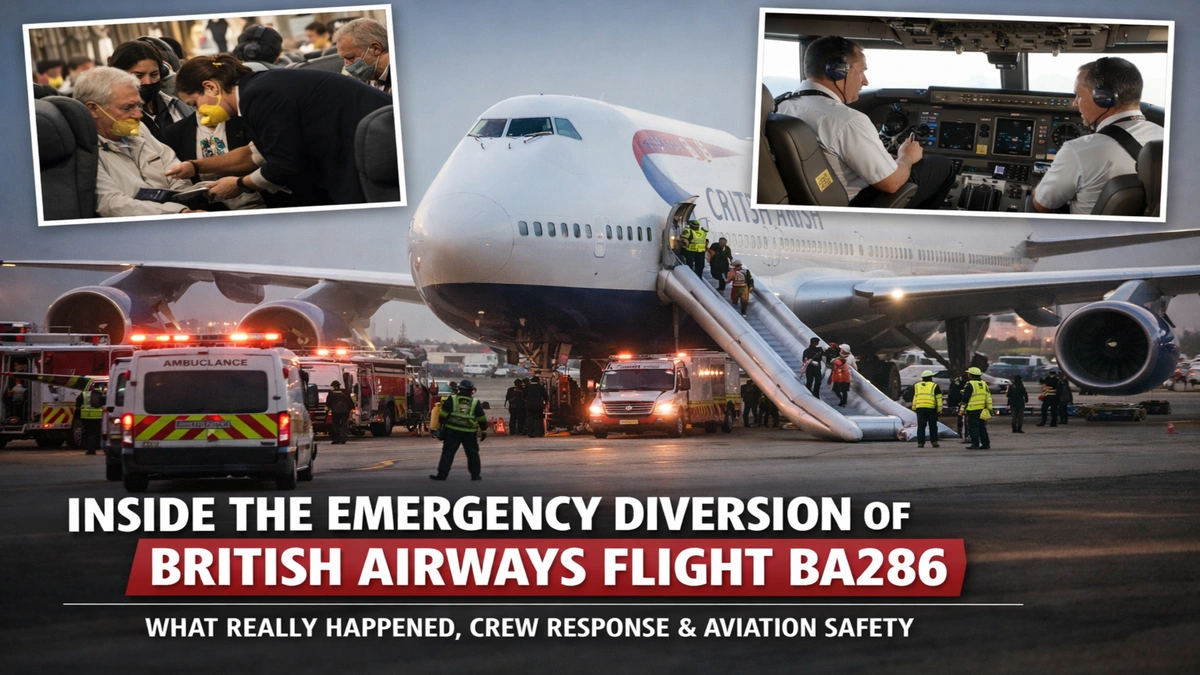

British Airways Flight BA286, operating a scheduled long-haul service between San Francisco and London Heathrow, became an unexpected focal point of global aviation attention when it declared a full emergency mid-flight and diverted to Vancouver. For readers searching this incident, the intent is clear: what happened, why the diversion occurred, and what it reveals about airline safety. Within the first moments, the essential facts stand out. A health-related emergency affecting cabin crew led the flight crew to activate a general emergency code, initiate a diversion, and land at the nearest suitable international airport with full emergency services on standby.
The aircraft involved was an Airbus A380, one of the largest passenger jets in commercial service, carrying hundreds of passengers across the North American continent toward the Atlantic. Emergencies aboard such aircraft are rare, but when they occur, they test not only technology but also human judgment, training, and coordination between cockpit, cabin, air traffic control, and ground responders.
The BA286 incident sits at the intersection of aviation safety, occupational health, and crisis management. It highlights how airlines prepare for scenarios that may never unfold, yet must be handled decisively when they do. Beyond the immediate drama of an emergency landing, the event raises broader questions about cabin environments, crew well-being, and the systems designed to protect everyone onboard. Examining BA286 in detail offers insight into how modern aviation manages risk, uncertainty, and human vulnerability at cruising altitude.
Read: Delta DL275 Diverted LAX After Mid-Air Safety Alert
Flight Background and Aircraft Context
Flight BA286 is a regularly scheduled British Airways service connecting San Francisco International Airport with London Heathrow, one of the airline’s flagship transatlantic routes. On the day of the incident, the flight departed San Francisco in the evening, operating normally through climb and into cruise. The aircraft assigned to the route was an Airbus A380-841, a double-deck wide-body jet designed for high-capacity, long-range operations.
The A380’s design incorporates multiple layers of redundancy, including advanced avionics, environmental control systems, and continuous monitoring of pressurization and airflow. These systems are intended to provide a stable cabin environment for passengers and crew over flights lasting more than ten hours. However, even with modern engineering, operational safety still depends on human awareness and timely response to irregular conditions.
Long-haul flights over North America involve extended periods away from diversion airports capable of handling large aircraft. Flight planning therefore includes predefined alternates, fuel contingencies, and crew procedures for medical or environmental events. In the case of BA286, those preparations became immediately relevant once the situation onboard escalated beyond routine operations.
The Moment the Emergency Unfolded
While cruising at altitude, the flight crew identified a situation serious enough to warrant immediate priority handling. The aircraft’s transponder was set to squawk 7700, the universal code indicating a general emergency. This single action instantly alerted air traffic controllers and nearby aviation authorities that BA286 required unrestricted routing, priority descent, and emergency coordination on the ground.
Reports from the aircraft indicated that several cabin crew members were experiencing symptoms consistent with a possible air-quality or contamination issue. Although the precise cause was not immediately known, the impact on crew functionality was significant enough to raise concerns about continued safe operation to the original destination. The captain, in consultation with airline operations and air traffic control, elected to divert the flight.
Vancouver International Airport was selected due to its proximity, long runways suitable for an A380, and full emergency medical capabilities. Before landing, the aircraft conducted fuel-dumping procedures to reduce weight, a standard precaution for wide-body aircraft executing unscheduled landings. This sequence reflects a critical principle of aviation safety: when uncertainty threatens crew capability, conservative decisions take precedence over schedule or commercial considerations.
Cabin Crew Health and Environmental Concerns
Central to the BA286 emergency was the reported impairment of cabin crew. Cabin crew members are not only service providers but essential safety professionals responsible for emergency response, passenger management, and evacuation if required. Any event that compromises their ability to perform these duties is treated with extreme seriousness.
In aviation, incidents involving unusual odors, fumes, or suspected contamination fall under a category often referred to as cabin air or fume events. These events can stem from a range of sources, including mechanical issues, airflow anomalies, or external contaminants entering the ventilation system. Even when no definitive cause is immediately identified, the symptoms experienced by crew are sufficient to trigger emergency protocols.
Upon landing, affected crew members were assessed by medical teams as a precaution. Some were transported to hospitals for further evaluation, while others were examined on site. The emphasis throughout was on caution rather than diagnosis, reflecting an industry approach that prioritizes health protection when potential exposure cannot be ruled out.
Read: Inside the United Airlines Flight UA770 Emergency Diversion
Passenger Experience During the Diversion
For passengers onboard BA286, the diversion transformed an ordinary overnight flight into an unexpected and tense experience. In such situations, communication becomes as important as technical response. Pilots and cabin crew are trained to provide clear, calm explanations that balance transparency with reassurance.
Announcements informed passengers of the diversion decision, the reason for landing early, and what to expect upon arrival. While uncertainty can heighten anxiety, visible professionalism and orderly procedures often help maintain confidence. Emergency vehicles positioned along the runway and near the gate underscored the seriousness of the situation, yet also reassured passengers that comprehensive support was in place.
After landing, passengers remained onboard or disembarked in stages as medical assessments were carried out. Airline ground teams coordinated accommodations, rebooking, and onward travel plans. For many travelers, the incident became a vivid reminder that aviation safety systems are designed to respond decisively, even when the inconvenience is significant.
Emergency Response on the Ground
Vancouver International Airport activated its emergency response plan as soon as BA286 declared its diversion. Fire crews, medical teams, and airport operations staff were positioned prior to landing, ensuring immediate access once the aircraft was on the ground.
Such coordination is the result of extensive planning between airports, airlines, and local authorities. Emergency drills regularly rehearse scenarios involving large aircraft, medical triage, and passenger handling. In the BA286 case, these preparations enabled a controlled response that minimized confusion and allowed medical professionals to focus on crew health assessments without delay.
The aircraft itself was secured for inspection, with engineering teams later examining systems related to air circulation and environmental control. While passengers often see only the visible response, these behind-the-scenes actions are essential for determining whether mechanical factors played any role in the incident.
Regulatory Oversight and Investigation
Incidents involving emergency diversions and crew illness automatically draw the attention of aviation safety authorities. Regulators examine available data to determine whether the event reflects an isolated occurrence or part of a broader pattern requiring intervention.
Investigations typically involve analysis of flight data, maintenance records, crew reports, and post-flight inspections. The objective is not to assign blame but to identify contributing factors and mitigate future risk. In cases involving potential cabin air issues, findings may inform updated maintenance procedures, design recommendations, or crew training protocols.
While full investigative reports are not always immediately public, the process itself reinforces confidence in aviation oversight. Each incident contributes to a growing body of safety knowledge that shapes industry standards globally.
Emergency Codes and Aviation Decision-Making
| Code | Meaning | Operational Impact |
|---|---|---|
| 7700 | General emergency | Full ATC priority, immediate diversion |
| 7600 | Radio communication failure | Procedural routing, monitoring |
| 7500 | Unlawful interference | Security response escalation |
| Medical diversion | Health emergency onboard | Nearest suitable airport selection |
Timeline of Key Events
| Timeframe | Event |
|---|---|
| Evening departure | BA286 leaves San Francisco |
| En route cruise | Crew health issue identified |
| Emergency declared | Squawk 7700 activated |
| Diversion decision | Vancouver selected |
| Landing | Emergency services deployed |
| Post-landing | Crew medical evaluations |
Expert Perspectives
Aviation Safety Analyst: “The decision to divert reflects a conservative safety culture where crew capability is treated as non-negotiable.”
Human Factors Specialist: “Cabin crew health is integral to flight safety, not secondary to it.”
Airline Operations Consultant: “Emergency diversions test the entire aviation ecosystem, from cockpit judgment to ground coordination.”
Takeaways
- Flight BA286 diverted due to crew health concerns.
- Emergency code 7700 ensured immediate priority handling.
- Vancouver was chosen for its infrastructure and medical capacity.
- Cabin crew health directly affects operational safety.
- Such incidents inform continuous safety improvements.
Conclusion
The emergency diversion of British Airways Flight BA286 illustrates how aviation safety depends on vigilance, decisiveness, and respect for human limits. While the precise cause of the crew illness may remain technical or unresolved for the public, the response itself demonstrates the strength of established protocols. From the cockpit’s early recognition of risk to the ground response awaiting the aircraft, the system functioned as intended.
For passengers, the incident may have been unsettling, but it ultimately reinforced a core truth of modern air travel: safety overrides schedule, cost, and convenience. BA286 stands as a reminder that aviation’s layered defenses—technical, procedural, and human—are designed to manage uncertainty long before it becomes catastrophe.
Frequently Asked Questions
Why did BA286 divert?
Crew members experienced health symptoms that raised safety concerns.
Where did the aircraft land?
The flight diverted to Vancouver International Airport.
Was the aircraft damaged?
No public information indicates structural damage; inspections were precautionary.
What does squawk 7700 mean?
It signals a general emergency requiring immediate priority.
Did passengers continue their journey?
Passengers were rebooked and accommodated by the airline.
References
- AirLive. (2025, May 27). British Airways A380 flight BA286 from San Francisco declares an emergency.
https://airlive.net/emergency/2025/05/27/british-airways-a380-flight-ba286-from-san-francisco-is-declaring-an-emergency/ - Aviation Safety Network. (2025). Incident overview: British Airways Airbus A380 emergency diversion.
https://aviation-safety.net - FlightAware. (n.d.). BA286 (British Airways) flight tracking and history.
https://www.flightaware.com/live/flight/BAW286 - International Civil Aviation Organization. (2018). Aircraft accident and incident investigation manual (Doc 9756).
https://www.icao.int/safety/airnavigation/AIG/Pages/default.aspx - Sky News. (2016, October 25). British Airways flight diverted after crew fall ill.
https://news.sky.com/story/british-airways-flight-to-london-heathrow-diverted-as-crew-falls-ill-10631780 - UK Civil Aviation Authority. (2023). Aviation safety and emergency response guidance.
https://www.caa.co.uk/safety/ - Federal Aviation Administration. (2022). Aeronautical information manual: Emergency procedures.
https://www.faa.gov/air_traffic/publications/atpubs/aim_html/ - Airbus. (2024). A380 aircraft characteristics and environmental control systems.
https://www.airbus.com/en/products-services/commercial-aircraft/passenger-aircraft/a380