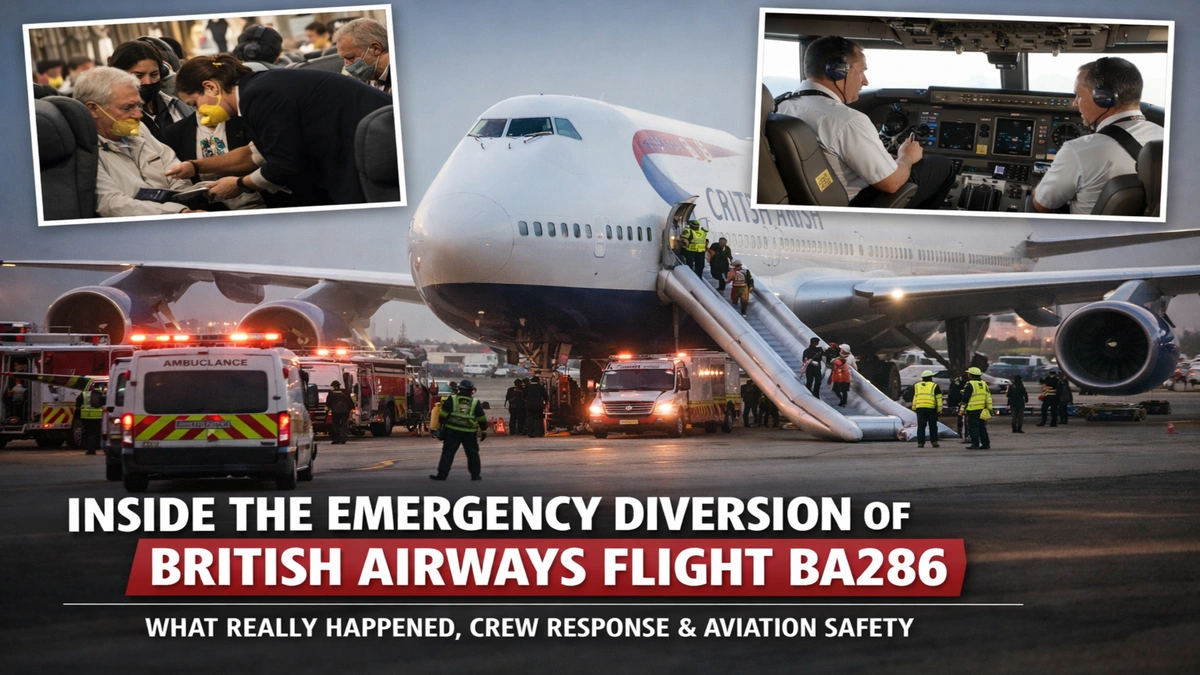
British Airways Flight BA286 was never supposed to become a headline. Scheduled to fly routinely from San Francisco to London Heathrow, the Airbus A380 was expected to carry its passengers quietly across the Atlantic, another overnight journey stitched into the vast fabric of global aviation. Instead, a subtle but alarming disruption — a strange odor and crew members feeling unwell — transformed a standard long-haul service into an emergency diversion that tested the airline’s systems, its people, and its preparedness. – british airways emergency flight ba286
About two hours after departure, while cruising high above western Canada, cabin crew noticed a persistent noxious smell in parts of the aircraft. Several crew members began reporting symptoms of dizziness and discomfort. The situation was not immediately life-threatening, but it was uncertain, and uncertainty at altitude is treated as a risk in itself. The flight crew consulted with airline operations and declared a PAN PAN urgency call, signaling a serious situation that required priority handling but did not rise to the level of an imminent catastrophe.
The captain decided to divert the aircraft to the nearest airport capable of handling an A380. Calgary was considered but ruled out due to runway and support limitations. Vancouver, with its long runways and emergency infrastructure, became the destination. The aircraft dumped fuel to reduce landing weight, donned oxygen masks as a precaution, and descended safely into Vancouver, where emergency services were waiting.
No one died. No one was seriously injured. Yet the incident resonated because it illustrated how fragile “normal” is in aviation, and how quickly routine becomes responsibility. BA286 became a case study in how airlines manage health risks, technical ambiguity, and human judgment in the sky.
Read: MissAV: Uncovering the Rise, Risks and Legal Fallout of a Global Pirate Platform
What Happened on Flight BA286
Flight BA286 departed San Francisco with more than 400 passengers and over two dozen crew members onboard. The Airbus A380, the largest passenger aircraft in commercial service, is designed with redundant systems, advanced air filtration, and strict safety protocols.
The first sign of trouble was sensory rather than mechanical. A strong, unpleasant odor appeared in parts of the cabin, reportedly near a galley area and a main door. Smells on aircraft can originate from many sources: overheated electrical components, contamination in air systems, cleaning chemicals, or even food waste interacting with cabin airflow. – british airways emergency flight ba286
What elevated concern was not the smell alone but the human response. Crew members began to feel unwell. Aviation safety doctrine treats crew incapacitation as a major operational risk, because crew health is directly tied to passenger safety. Even if passengers feel fine, compromised crew members mean compromised emergency response capability.
The captain did not wait for definitive answers. Aviation training emphasizes early intervention rather than delayed certainty. The PAN PAN call gave air traffic controllers notice that the aircraft needed priority routing and assistance. It also allowed the flight to divert without creating panic or triggering the more severe MAYDAY protocols.
The Decision to Divert
Diverting an Airbus A380 is not trivial. It requires a runway long enough to handle the aircraft’s weight, airport services capable of managing hundreds of passengers, and emergency responders prepared for a wide range of possibilities.
Calgary was initially considered because it was geographically closer. But not all international airports are equipped for the A380’s size and ground handling needs. Vancouver International Airport was chosen because it met all requirements and had full emergency and medical facilities.
Before landing, the aircraft dumped fuel to reduce landing weight — a standard procedure for large jets making unscheduled landings shortly after departure. Crew members used oxygen as a precaution. The aircraft landed without incident.
On the ground, emergency vehicles surrounded the plane, not because something had gone wrong, but because something might have. Several crew members were transported to hospitals for evaluation. All were later released.
Passengers were kept informed, rebooked, and accommodated overnight. The crisis, operationally speaking, was over. But its implications were just beginning.
Human Factors in Aviation Safety
Modern aviation is as much about psychology and physiology as it is about engineering. Aircraft systems are designed to be resilient. Humans are not always so predictable. – british airways emergency flight ba286.
Cabin environments involve controlled pressure, recycled air, humidity fluctuations, and exposure to materials that most people never encounter on the ground. A minor malfunction, contamination, or chemical interaction can have outsized effects in this closed environment.
From a safety perspective, the most important factor was not identifying the odor’s exact chemical composition but recognizing that crew members were experiencing symptoms. That alone justified action.
One aviation safety analyst noted that the pilots’ response reflected best practice: treat ambiguous threats as real until proven otherwise. Another pointed out that aviation culture has shifted over decades toward early caution rather than heroic endurance. The goal is not to push through problems but to neutralize them early. – british airways emergency flight ba286.
This philosophy likely prevented a minor incident from escalating into something far more serious.
Crisis Management in Real Time
The BA286 diversion illustrates how layered aviation safety truly is.
First layer: detection. The cabin crew noticed something unusual and reported it promptly.
Second layer: evaluation. The cockpit crew assessed information, consulted operations, and classified the severity.
Third layer: communication. The PAN PAN call coordinated air traffic, airline operations, and emergency services.
Fourth layer: execution. The aircraft diverted, dumped fuel, landed safely, and transferred care to ground responders.
At no point did any single individual “save the day.” Instead, a system of procedures, training, and communication worked as designed. This is precisely how modern safety culture aims to function: not heroism, but reliability.
Timeline of the Incident
| Phase | Description |
|---|---|
| Departure | BA286 leaves San Francisco bound for London Heathrow |
| Detection | Cabin crew notice a noxious odor and feel unwell |
| Assessment | Cockpit consults operations and evaluates risk |
| Declaration | PAN PAN urgency declared |
| Diversion | Calgary ruled out, Vancouver selected |
| Descent | Fuel dumped, oxygen used as precaution |
| Landing | Aircraft lands safely in Vancouver |
| Response | Medical checks conducted, passengers rebooked |
Comparison: Standard Protocol vs BA286
| Element | Standard Practice | BA286 Response |
|---|---|---|
| Odor detection | Monitor and report | Reported immediately |
| Crew illness | Assess severity | Treated as safety risk |
| Emergency call | PAN PAN for urgency | PAN PAN used |
| Diversion | Nearest suitable airport | Vancouver chosen |
| Medical response | Precautionary checks | Crew evaluated and released |
Public Perception and Trust
Passengers trust airlines not because nothing ever goes wrong, but because when something does go wrong, it is handled competently.
The BA286 incident did not cause panic because communication remained calm and transparent. Passengers were told what was happening, why the diversion was necessary, and what would happen next.
Trust in aviation is built on this quiet professionalism. Most people will never understand the full complexity of air systems, but they understand care, clarity, and visible preparedness.
The incident also highlighted a tension inherent in aviation reporting: rare events attract attention precisely because they are rare. The industry must balance openness with reassurance, acknowledging risk without exaggerating it.
What BA286 Reveals About Modern Aviation
BA286 shows that aviation safety is no longer just about preventing crashes. It is about managing uncertainty, protecting human health, and responding gracefully to imperfect information.
The event reinforced several truths:
Technology cannot eliminate all risks.
Humans remain central to safety.
Early caution prevents later catastrophe.
Trust is maintained through transparency and competence.
These are not abstract lessons. They are operational principles that guide daily decisions in cockpits around the world.
Takeaways
- Flight BA286 diverted due to crew illness and a strange odor, not a mechanical failure.
- The crew prioritized safety over schedule.
- The aircraft landed safely with no serious injuries.
- The response followed established emergency and health protocols.
- The incident highlighted the importance of human factors in aviation safety.
- Public trust depends on how incidents are managed, not on their absence.
Conclusion
British Airways Flight BA286 never became a tragedy, and that is precisely why it matters. Its significance lies not in what went wrong, but in what went right.
A subtle warning sign was taken seriously. A complex machine was guided safely to the ground. Hundreds of people were inconvenienced but unharmed. A system designed for rare events proved itself quietly effective.
In an era when technology often promises certainty, BA286 reminds us that uncertainty is inevitable — and that resilience is built not by denying it, but by preparing for it. The calm professionalism shown by the crew, controllers, and ground teams reflects an industry that has learned from history and continues to refine its response to the unknown.
The story of BA286 is not one of danger, but of discipline. Not of failure, but of foresight. It is a reminder that safety is not a state achieved once, but a process renewed every day, every flight, every decision at altitude.
FAQs
Why did Flight BA286 divert?
Because crew members felt unwell after noticing a noxious odor, and the captain chose to prioritize safety.
Was there a mechanical failure?
No confirmed mechanical fault was publicly identified; the concern was environmental and medical.
Did anyone get seriously hurt?
No. Crew members were evaluated and released, and passengers were unharmed.
Why wasn’t the flight continued after landing?
The aircraft and crew needed evaluation before returning to service, and passengers were rebooked.
Is this type of incident common?
No. Such diversions are rare but part of aviation’s precautionary safety system.