
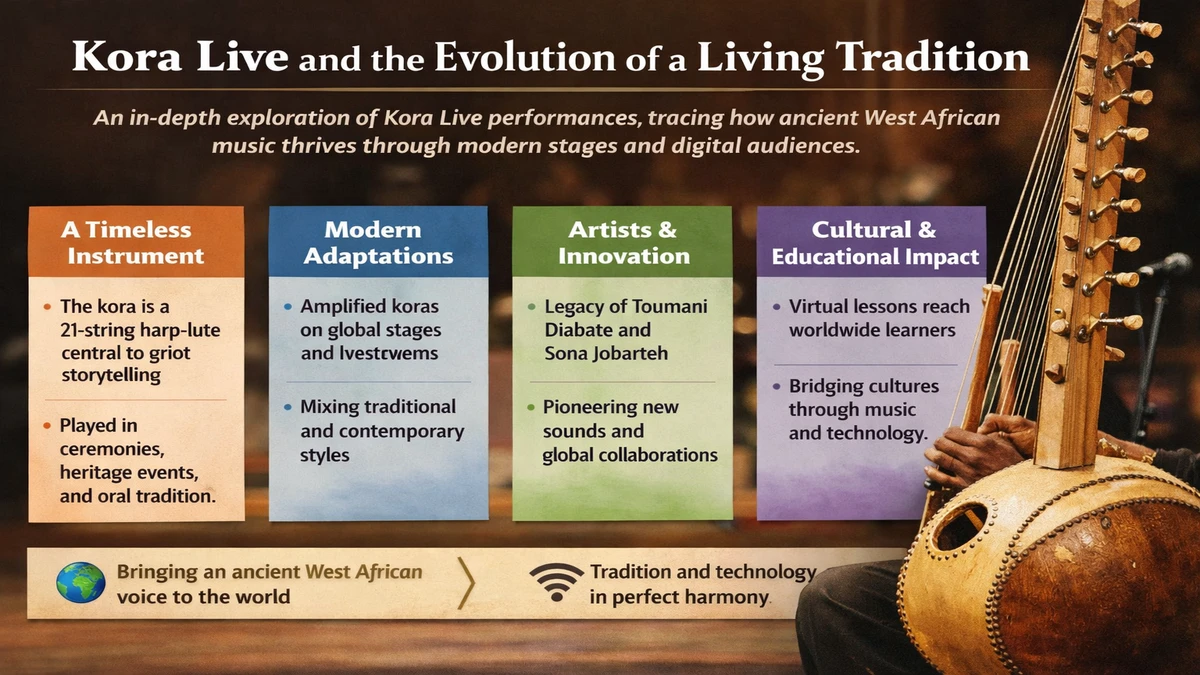
Kora Live refers to the experience of hearing, watching, or participating in kora performances as they happen, whether on a village stage in West Africa, a concert hall in Europe, or through a live digital broadcast reaching listeners worldwide. In its simplest sense, it is about immediacy: the sound of twenty-one strings vibrating in the present moment, shared between performer and audience without delay. For many listeners searching for “Kora Live,” the intent is clear. They want to understand what the kora is, how it is performed today, and why live performance matters so deeply to its cultural meaning.
The kora itself is a bridge between music and history. Originating within the Mandinka cultural sphere of West Africa, particularly in regions that once formed the Mali Empire, the instrument has long been associated with jali, or griots: hereditary musicians who serve as historians, genealogists, and storytellers. Their performances are not simply concerts but acts of remembrance, social commentary, and communal affirmation. In live settings, the kora’s bright, cascading tones accompany praise songs, epics, and reflections on contemporary life.
In the modern era, Kora Live has expanded beyond its traditional settings. Amplification, professional stages, and live streaming technologies now allow these performances to travel far beyond their original communities. Yet the essence remains the same. A live kora performance is still built on interaction, improvisation, and emotional exchange. Understanding Kora Live, therefore, means understanding how an ancient musical practice adapts to modern platforms while retaining its cultural core.
The Kora and Its Living Tradition
The kora is often described as a harp-lute, though such labels only partially capture its uniqueness. Constructed from a large calabash gourd cut in half and covered with tightly stretched animal hide, it produces a resonant chamber that supports a long hardwood neck. Twenty-one strings run from the neck to a bridge, divided into two ranks that are plucked using the thumbs and forefingers of both hands. This technique allows players to weave melody, bass, and rhythmic accompaniment simultaneously.
Traditionally, koras were built and maintained using organic materials, with tuning achieved by sliding leather rings along the neck. The instrument’s sound was intimate yet penetrating, ideal for outdoor gatherings, royal courts, and ceremonial occasions. Performance was inseparable from social function. A griot playing the kora was expected not only to entertain but also to educate, praise, advise, and sometimes gently criticize through song.
Kora Live performances preserve this tradition of responsiveness. Unlike fixed compositions in some Western classical traditions, kora music often unfolds in dialogue with the audience. Requests, reactions, and the atmosphere of the moment shape the music as it happens. This is one reason live performance remains central to the kora’s identity. Recorded music can capture technique, but only live performance fully conveys the relational nature of the art.
From Village Courtyards to Global Stages
For centuries, kora performance was closely tied to local contexts: weddings, naming ceremonies, harvest celebrations, and gatherings of nobility. These events were deeply embedded in community life, and the audience often knew the performer personally. Kora Live in these settings was communal, participatory, and grounded in shared history.
As West African musicians began traveling internationally in the late twentieth century, the kora entered new performance spaces. Concert halls, festivals, and cultural exchanges introduced the instrument to audiences unfamiliar with its background. Live performance became a means of translation, conveying cultural values through sound rather than words. The visual presence of the kora, large and elegant, also played a role in captivating audiences seeing it for the first time.
Modern Kora Live performances now occur on some of the world’s most prestigious stages. While the context has changed, many performers consciously maintain traditional elements, such as storytelling, audience address, and improvisation. The result is a layered experience: ancient forms expressed within contemporary frameworks.
Traditional and Modern Performance Contexts
| Aspect | Traditional Kora Live | Contemporary Kora Live |
|---|---|---|
| Setting | Village, court, ceremony | Concert halls, festivals, online |
| Audience | Local community | Global, diverse |
| Technology | Fully acoustic | Amplification, streaming |
| Repertoire | Oral tradition | Traditional plus new compositions |
| Interaction | Direct, communal | Direct and digital |
This evolution illustrates that Kora Live is not a replacement of tradition but an expansion of it. Each context adds new possibilities while drawing from the same foundational practices.
Artists Who Shape Kora Live Today
The global recognition of the kora owes much to a lineage of master musicians who have carried the instrument beyond its regional origins. Figures such as Toumani Diabaté demonstrated that the kora could converse fluently with jazz, blues, and classical music without losing its identity. His live performances, often marked by extended improvisation, showed international audiences the depth and flexibility of the instrument.
Ballaké Sissoko represents another approach, blending subtle innovation with deep respect for tradition. His live concerts emphasize intimacy and nuance, drawing listeners into the delicate interplay of strings. Each performance feels carefully shaped by the space and the moment, reinforcing the importance of liveness.
Sona Jobarteh has expanded the meaning of Kora Live in yet another direction. As one of the first internationally recognized female kora virtuosos from a griot family, her presence on stage challenges long-standing gender norms. Her live performances often combine traditional pieces with new compositions that address education, social responsibility, and cultural pride.
Expert observers frequently note that these artists succeed not because they abandon tradition, but because they embody it fully while responding to contemporary realities. As one ethnomusicologist has observed, the kora survives precisely because it is practiced as a living art, not a museum artifact.
Technology and the Rise of Digital Kora Live
One of the most significant developments in recent decades has been the integration of technology into kora performance. Modern koras are often fitted with machine tuning heads for stability and pickups that allow the instrument to be amplified without sacrificing tonal clarity. This has made it possible for the kora to compete sonically with louder ensembles and larger venues.
Live streaming has further transformed Kora Live. Performers can now broadcast concerts, workshops, and informal practice sessions to audiences across continents. For members of the African diaspora, these streams offer a powerful sense of connection to cultural roots. For new listeners, they provide accessible entry points into a rich musical tradition.
Technology has also enabled interactive learning. Students can observe live technique, ask questions in real time, and receive feedback from master musicians thousands of miles away. This digital extension of apprenticeship ensures that kora knowledge continues to circulate even as social structures change.
Uses of Kora Live in the Modern World
| Context | Purpose | Impact |
|---|---|---|
| Live concerts | Artistic expression | Cultural visibility |
| Educational streams | Teaching technique and history | Skill transmission |
| Festivals | Cross-cultural exchange | New collaborations |
| Community events | Social cohesion | Cultural continuity |
| Online broadcasts | Global access | Expanded audiences |
These varied uses demonstrate how Kora Live functions simultaneously as art, education, and cultural diplomacy.
Cultural Meaning and Audience Experience
Listening to Kora Live is often described as both calming and emotionally stirring. The interlocking patterns of the strings create a sense of motion without urgency, allowing listeners to settle into the sound. In live settings, this effect is heightened by visual cues: the movement of the player’s hands, the resonance of the calabash, and the subtle shifts in dynamics.
Audience engagement remains central. Even in large venues or online platforms, performers frequently address listeners directly, explain the stories behind pieces, or respond to audience energy through improvisation. This reinforces the kora’s traditional role as a medium of dialogue rather than one-way presentation.
Cultural scholars emphasize that this relational quality is key to understanding Kora Live. The performance is not complete without an audience, and the audience is not passive. Together, they co-create the moment.
Takeaways
- Kora Live refers to real-time performance of the kora in both traditional and modern contexts.
- The kora is deeply tied to West African griot traditions of history and storytelling.
- Live performance emphasizes interaction, improvisation, and community connection.
- Modern technology has expanded the reach of Kora Live without erasing tradition.
- Contemporary artists continue to redefine how the kora is heard and seen globally.
- Digital platforms support education, preservation, and cross-cultural exchange.
Conclusion
Kora Live stands as a powerful example of how cultural traditions endure by remaining dynamic. Rooted in centuries of West African history, the kora continues to speak to present-day audiences because it is performed live, in dialogue with its listeners. Whether heard in a rural courtyard, a major concert hall, or through a digital stream, the instrument carries with it a sense of immediacy and human connection.
As technology reshapes how music is shared, Kora Live shows that innovation does not have to mean loss. Instead, it can mean reach, resilience, and renewal. The live kora performance remains an act of storytelling, memory, and artistry, reminding audiences that some sounds gain their deepest meaning only when experienced in the moment they are created.
FAQs
What does Kora Live mean?
It refers to live or real-time performances of the kora, including concerts, ceremonies, and digital livestreams.
Why is live performance important for the kora?
Because kora music relies on interaction, improvisation, and audience response, which are central to its tradition.
Can the kora be played in modern concert settings?
Yes, modern koras often use amplification, allowing them to be performed on large stages.
Is Kora Live only traditional music?
No, it includes traditional repertoire as well as new compositions and cross-genre collaborations.
Who can learn from Kora Live performances?
Both aspiring musicians and general audiences benefit through exposure, education, and cultural understanding.