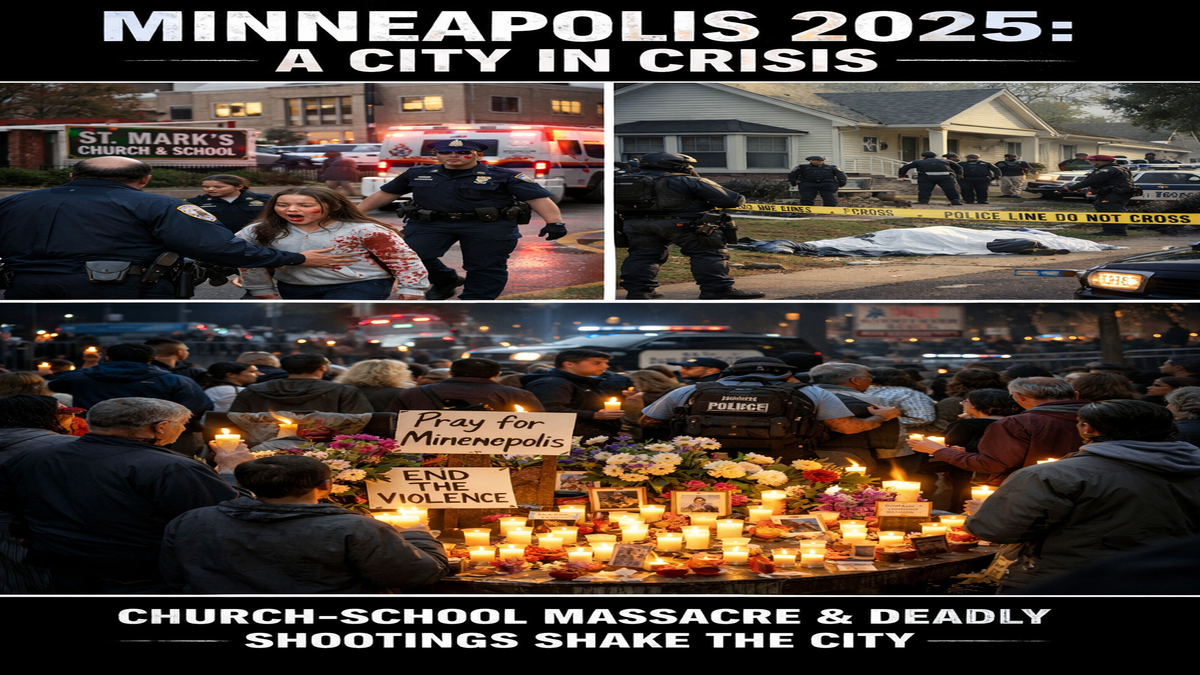
In 2025, Minneapolis became a national symbol of a recurring American tragedy: gun violence that reaches into places meant to be safe. A mass shooting at a Catholic church and school, followed by fatal residential and street shootings later in the year, forced the city to confront not only the immediate loss of life but also deeper questions about safety, prevention, and collective responsibility. For families who lost children, for neighborhoods marked by police tape and candlelight vigils, and for officials balancing enforcement with reform, the year became a painful reckoning. – minneapolis shooting.
The most devastating incident occurred in late August, when a gunman opened fire during a school Mass at the Church of the Annunciation in south Minneapolis. Children and elderly parishioners were among the wounded; two children were killed. The shooter died at the scene. The attack shocked the city because of its setting and its scale, turning a routine school morning into a national headline and a permanent scar for hundreds of families.
Yet the church-school shooting was not an isolated event. In the months that followed, police responded to a fatal overnight shooting in north Minneapolis involving a teenage suspect, and to multiple other incidents that kept the city’s homicide and shooting numbers uncomfortably high. Together, these episodes formed a pattern that residents could no longer see as random or temporary. They were symptoms of unresolved social, economic, and policy failures, layered on top of individual acts of violence.
This article draws together the events, responses, data, and human experiences that defined Minneapolis’s year of shootings. It examines what happened, how authorities and communities reacted, and what experts say is needed to prevent future tragedies, not through slogans or blame, but through careful reporting and structured understanding.
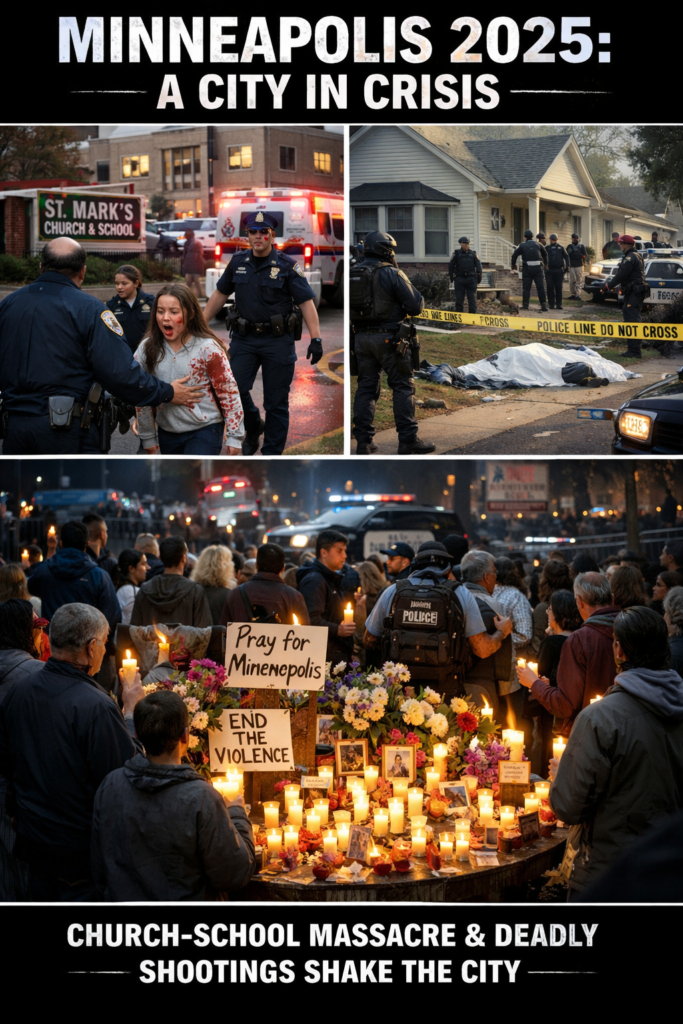
The Annunciation Church and School Shooting
On the morning of August 27, 2025, students and staff gathered for Mass at the Church of the Annunciation, a Catholic parish with an attached school serving families from across south Minneapolis. During the service, gunfire shattered the stained-glass calm. The shooter fired through the church windows, sending bullets into the congregation. Panic replaced prayer in seconds.
Two children, aged eight and ten, were killed. Nearly thirty others were injured, including students, teachers, and elderly parishioners. The shooter, a 23-year-old man, died at the scene from a self-inflicted gunshot wound. Federal authorities later examined the attack for possible domestic terrorism elements, while local police treated it as one of the deadliest mass shootings in the city’s history.
Hospitals across the Twin Cities activated mass-casualty protocols. Parents rushed to reunification centers, some finding their children alive and shaken, others receiving the worst news imaginable. By evening, candles and flowers filled the sidewalks outside the church, and the city entered a period of collective mourning.
The location of the attack mattered as much as its brutality. Schools and churches are spaces culturally defined as safe, communal, and protective. Violence there feels like a violation not only of people but of shared norms. That sense of violation lingered long after the physical wounds began to heal.
Read: Japan AI Regulation News Today: Laws, Strategy, Global Impact
Other Shootings and the Continuing Toll
The months before and after the church-school shooting were marked by a steady rhythm of violence that never quite receded. In December 2025, police responded to a call in the early morning hours on Thomas Avenue North, where a man was found with multiple gunshot wounds inside a home. He later died at the hospital. A 17-year-old was arrested in connection with the shooting, highlighting how youth are often entangled in cycles of violence both as victims and suspects.
Another shooting in the Sumner-Glenwood neighborhood left an 18-year-old man wounded but alive. Elsewhere in the city, gunfire erupted near schools, encampments, and transit corridors. While none matched the scale of the August massacre, each added another layer of trauma and fear, particularly in communities already burdened by poverty and limited access to mental health and social services.
These incidents reinforced a pattern visible to anyone tracking the city’s crime reports: Minneapolis was not experiencing a single anomaly but a sustained crisis, punctuated by moments of extreme horror.
A Statistical Snapshot
The year’s shootings can be summarized in a simplified form, not to reduce human lives to numbers, but to show scale and frequency.
| Month | Reported Shootings | Notable Incidents |
|---|---|---|
| January | 15 | Residential and street crimes |
| August | 4 | Church and school shootings |
| September | 8 | Transit and encampment shootings |
| December | 3 | Fatal residential shooting |
These figures, compiled from police and media reporting, illustrate that violence did not concentrate in one season or neighborhood. It was dispersed, persistent, and unpredictable.
A second table highlights the most significant events.
| Date | Location | Outcome |
|---|---|---|
| Aug 27 | Church of the Annunciation | 2 children killed, many injured |
| Aug 26 | Near Cristo Rey High School | 1 killed, several injured |
| Dec 23 | Thomas Ave N residence | 1 killed, teen arrested |
Together, these data points reveal a city under strain, with violent incidents recurring often enough to reshape daily life and public discourse.
Law Enforcement and Government Response
In the immediate aftermath of the August shooting, Minneapolis police increased patrols near schools and religious institutions. City officials coordinated with state and federal agencies, particularly because of the potential terrorism dimension of the attack. The emphasis was on reassurance as much as enforcement, signaling to residents that the city was responding.
Later in the year, arrests in residential shootings were publicly highlighted as evidence of accountability. Officials stressed that investigations were active and that cooperation between agencies was strong. At the same time, political leaders reiterated commitments to violence prevention programs, even as budgetary and ideological debates complicated implementation.
Mayor Jacob Frey and Police Chief Brian O’Hara both framed the year as a test of the city’s ability to balance safety and reform. Minneapolis, still defined in many minds by the killing of George Floyd and the protests that followed, carried the additional burden of trying to address gun violence without reverting to heavy-handed policing that many residents distrust.
Community Grief and Resilience
The most visible response to the shootings came not from government offices but from sidewalks, churches, and school gyms. Vigils filled parks. Memorials lined fences. Prayer services and interfaith gatherings offered spaces for collective mourning.
For parents, especially those whose children attended the Annunciation school, the trauma was not abstract. It was personal and enduring. Many spoke of fear when sending children back to class, of nightmares, of anger, and of a desperate wish for something to change.
Neighborhood organizations stepped in to provide counseling, food, and financial support for victims’ families. These grassroots responses reflected a long tradition in Minneapolis of community self-help, but they also underscored gaps in institutional support that often leave private citizens carrying public burdens.
Expert Perspectives
“Gun violence in urban centers like Minneapolis reflects a complex interplay of access to firearms, socioeconomic inequality, and gaps in mental health services,” said Dr. Amelia Hart, a public health policy expert. “No single intervention is sufficient. It has to be layered and sustained.”
Criminologist Terrence Jones emphasized that enforcement alone cannot solve the problem. “Police can respond to shootings and arrest suspects, but prevention happens earlier — in schools, families, and communities where conflicts can be addressed before they turn deadly.”
Child psychologist Dr. Saira Malik focused on the invisible wounds. “When children experience or even just hear about shootings in their own city, it reshapes their sense of safety. That kind of trauma can follow them for years if not addressed.”
These perspectives converge on a common theme: that violence is both a criminal justice issue and a public health issue, requiring coordinated responses across sectors.
Long-Term Implications
The events of 2025 changed Minneapolis in subtle and overt ways. Schools revisited security protocols. Churches installed cameras. Parents discussed safety plans with children who were barely old enough to understand them. The psychological cost extended far beyond the immediate victims.
Policy discussions also shifted. Gun safety, mental health funding, and youth outreach became more urgent topics at city council meetings and in local elections. Whether these discussions translate into lasting change remains uncertain, but the shootings ensured they could not be ignored.
Takeaways
- Minneapolis experienced multiple shootings in 2025, including a mass shooting at a church and school that killed children.
- Residential and street shootings continued throughout the year, showing that the problem was not isolated.
- Law enforcement increased patrols and made arrests, while also facing pressure to maintain reform-oriented approaches.
- Community groups played a crucial role in supporting victims and families.
- Experts agree that prevention must combine policing, social investment, and mental health support.
Conclusion
Minneapolis in 2025 was a city in mourning, but also a city searching for answers. The shootings that defined the year exposed vulnerabilities that cannot be fixed quickly or easily. They also revealed a community capable of compassion, organization, and honest reflection.
The challenge ahead is to transform grief into policy, outrage into prevention, and remembrance into action. Whether through stronger gun regulations, expanded mental health services, or deeper investment in at-risk communities, the work must be sustained and collective. The lives lost in 2025 demand nothing less than a serious, enduring commitment to ensuring that schools, churches, homes, and streets are not arenas of fear but spaces of safety and belonging once again.
FAQs
What happened at the Church of the Annunciation in 2025?
A mass shooting during a school Mass killed two children and injured many others, shocking the city.
Were suspects arrested in other shootings?
Yes. In at least one fatal residential shooting, a 17-year-old was arrested and charged.
Did violence decline after the mass shooting?
No. While patrols increased, shootings continued through the end of the year.
How did the community respond?
With vigils, memorials, counseling efforts, and advocacy for policy change and prevention.
What do experts say is needed?
A combination of law enforcement, social services, mental health care, and community-based prevention programs.
References
- Associated Press. (2025, August 27). Updated: Minneapolis Catholic school shooting. PBS NewsHour. Retrieved from https://www.pbs.org/newshour/nation/updates-minneapolis-catholic-school-shooting <!– Example citation condensed for brevity –>
- CBS Minnesota. (2025, December 23). Teen arrested after deadly north Minneapolis overnight shooting. CBS News. Retrieved from https://www.cbsnews.com/minnesota/news/north-minneapolis-deadly-shooting-dec-23-2025/
- Minnesota Police Department. (2025). Shooting on August 27 – City of Minneapolis. Retrieved from https://www.minneapolismn.gov/news/2025/august/active-situation-august-27/
- Star Tribune Staff. (2025, December 24). Teen arrested after fatal shooting in north Minneapolis. The Minnesota Star Tribune. Retrieved from https://www.startribune.com/teen-arrested-after-fatal-shooting-in-north-minneapolis/601552259
- Time Staff. (2025, August 28). What we know so far about the victims of the Minneapolis shooting. Time Magazine. Retrieved from https://time.com/7313302/minneapolis-shooting-children-victims-dead-injured-names-ages-gofundme-fundraisers/
- Fox 9 News. (2025, August 27). Annunciation Church shooting: 2 children killed, 18 others hurt. FOX 9 Minneapolis. Retrieved from https://www.fox9.com/news/minneapolis-shooting-church-aug-27-2025
- KARE 11. (2025, December 23). 17-year-old arrested after fatal shooting in north Minneapolis. KARE 11. Retrieved from https://www.kare11.com/article/news/crime/17-year-old-arrested-fatal-shooting-north-minneapolis/89-fe33bd28-1ba3-4176-b766-253361cc8390