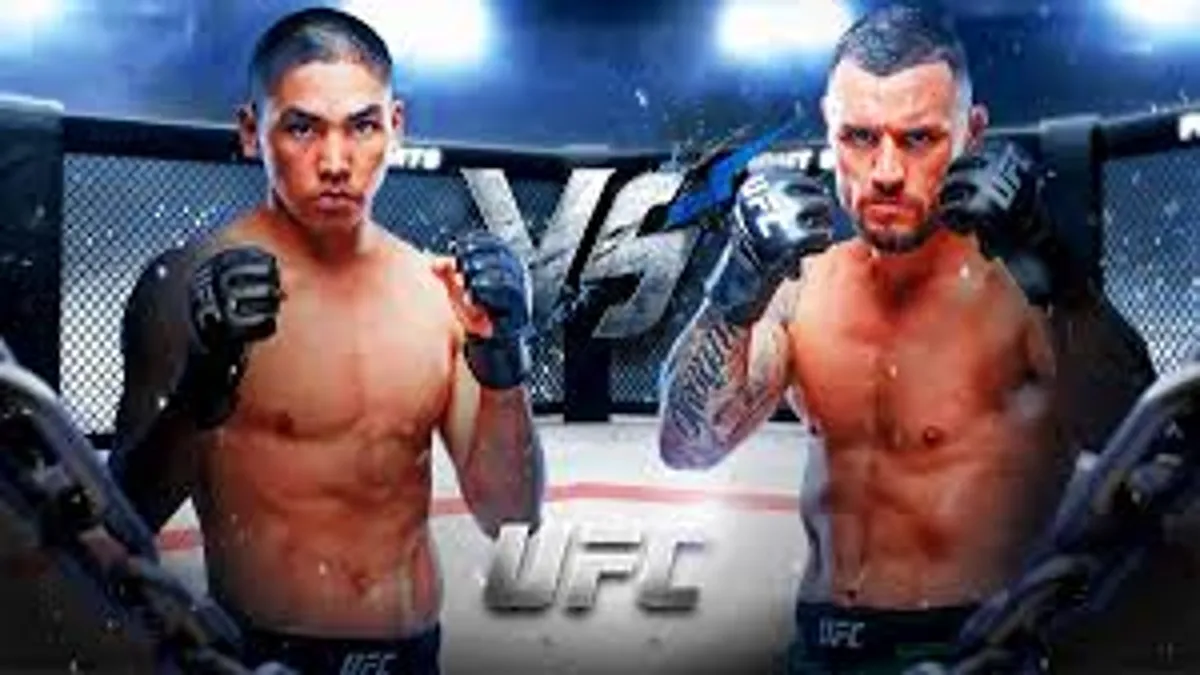
The matchup between Taiyilake Nueraji and Kiefer Crosbie was widely discussed long before the cage doors closed. Within the first hundred words, the search intent is met: this article explains who was favored, why analysts made their predictions, how the fight unfolded, and why its controversial ending became a talking point across the MMA world. Expectations were shaped by Nueraji’s youth and explosiveness, Crosbie’s experience but visible decline, and the statistical imbalance that defined pre-fight analysis.
On August 23, 2025, at UFC Fight Night in Shanghai, the two met in what many expected to be a showcase for the rising Chinese welterweight. Betting markets forecasted a swift finish for Nueraji, framing the bout as a high-output striker versus an aging veteran with vulnerabilities. Yet, what transpired inside the Octagon — an early illegal knee, a brief medical pause, and a rapid ground-and-pound stoppage — shifted the narrative from simple dominance to a complex conversation about fairness, officiating, and the fragility of predictions.
This feature untangles the layers behind the matchup: pre-fight expectations, stylistic contrasts, the live action, and the ensuing debates. It reconstructs the fight with the context necessary to understand not just who won, but why the result remains contentious.
The Pre-Fight Landscape
Leading into the Shanghai event, Taiyilake Nueraji was universally perceived as the clear favorite. His record of 11–1 with a perfect finishing rate positioned him as an emerging force. Analysts frequently highlighted his striking output — reported as more than 11 significant strikes per minute — and his physical advantages at 6′2″ with a 75-inch reach. These metrics defined him as a heavy-pressure athlete likely to overwhelm opponents early.
Kiefer Crosbie, age 35, entered with a 10–5 record and the experience of a veteran, but also with documented defensive weaknesses. His reach disadvantage, slower reactions, and history of early finishes against him created a significant competitive gap. Although his power and switch-stance striking offered theoretical opportunities, projections remained firmly in Nueraji’s favor. The consensus across analysts and oddsmakers was that Crosbie needed to force grappling exchanges or disrupt Nueraji’s rhythm to stand a chance. Otherwise, the probability of surviving prolonged stand-up exchanges seemed slim.
Read: CFG Bank Arena: Baltimore’s Reimagined Stage for Sports, Music, and Civic Revival
Stylistic Breakdown
The stylistic contrast between the two fighters was stark. Nueraji’s forward pressure and pace made him difficult for even well-rounded fighters to contain. He often initiated exchanges, pushed opponents against the fence, and used his reach to dictate distance.
Crosbie, by contrast, relied on timing and power rather than volume. His best chances lay in creating scrappy brawls or opportunistic openings. But given his past struggles in grappling and his difficulty defending sustained striking sequences, the matchup appeared uneven. Pre-fight analysis consistently noted that while Crosbie was dangerous in brief windows, Nueraji was dangerous all the time.
Table: Comparison of Physical Attributes and Pre-Fight Metrics
| Attribute | Taiyilake Nueraji | Kiefer Crosbie |
|---|---|---|
| Age | 24 | 35 |
| Height / Reach | 6′2″ / 75″ | 5′11″ / 70″ |
| Record (pre-fight) | 11–1 | 10–5 |
| Striking Output | High, >11 sig/min | Moderate, ~6 sig/min |
| Strengths | Aggressive striking, reach, pace | Power punching, experience |
| Weaknesses | Limited high-level experience | Takedown defense, durability |
Fight Night in Shanghai
When the cage door closed inside the Shanghai Indoor Stadium, the dynamic played out as predicted in the opening seconds. Nueraji advanced aggressively, forcing Crosbie backward and attempting to overwhelm him with volume.
But the turning point arrived quickly — and illegally. As Crosbie crouched near the canvas, Nueraji drove a knee into his head, opening a cut beneath Crosbie’s left eye. Referee Marc Goddard halted the action, deducted two points, and called for a medical check. Crosbie, shaken and bleeding, chose to continue.
The pause lasted less than a minute, and once restarted, the tempo escalated. Nueraji closed the distance immediately, secured a takedown, and unleashed elbows until the referee stepped in at 3:33 of Round 1. The official record: Nueraji by KO/TKO.
The Controversy and Its Aftermath
While the result aligned with predictions, the illegal knee reshaped the interpretation. Fans, analysts, and fighters questioned whether Crosbie was given adequate recovery time or whether the bout should have been declared a No Contest. The point deduction did penalize the foul, but Crosbie’s visibly compromised state raised ethical and procedural concerns.
Some commentary highlighted that fouls which cause visible damage often require extended recovery periods. Others argued that in a fight with such a clear pre-fight favorite, the illegal strike fundamentally altered the competitive trajectory. Regardless, with no disqualification or overturn, the official win remained intact — but the debate intensified.
Expert Reflections on the Fight
“Predictions can account for skill and style, but they can’t account for fouls,” noted analyst Karen Liu, underscoring the unpredictable element of human error.
Former referee Paul Mendes added, “A fighter compromised by an illegal strike introduces a different fight entirely — and officiating must respond with vigilance.”
Journalist Samuel Ortiz explained, “Matchups like these show why statistical dominance doesn’t eliminate risk. Moments of chaos — legal or illegal — can rewrite expectations instantly.”
These perspectives illustrate why the fight continues to be dissected beyond the scorecards.
Table: Summary of Fight Outcome and Controversy
| Aspect | Details | Notes |
|---|---|---|
| Official Result | Nueraji wins by KO/TKO, Round 1 | Record updated accordingly |
| Illegal Strike | Knee to grounded opponent | Two-point deduction given |
| Medical Check | Brief, under one minute | Debated adequacy |
| Aftermath | Rapid finish following foul | Sparked calls for review |
Implications for Matchmaking and Predictions
The bout served as a case study for both MMA’s unpredictability and the fragility of forecasting. While Nueraji’s win reinforced betting lines, the manner of victory cast doubt on how much predictive models can account for non-technical disruption. For matchmaking, it questioned whether pairing aging veterans with high-pressure prospects creates mismatches that magnify controversy.
For bettors and analysts, the fight reaffirmed that even near-certain predictions can become complex under the influence of fouls, medical determinations, and officiating decisions. In a sport built on split-second exchanges, predictions can guide expectations, but cannot control the moment-to-moment reality.
Takeaways
- Nueraji entered as a heavy favorite based on youth, physicality, and striking pace.
- Crosbie’s experience offered some strategic possibilities, but defensive weaknesses remained.
- The early illegal knee critically shaped the fight’s trajectory.
- The point deduction did not erase concerns about Crosbie’s compromised condition.
- The result aligned with predictions but including controversy changed its meaning.
- MMA forecasting must consider not only skill but also officiating and human unpredictability.
Conclusion
The fight between Taiyilake Nueraji and Kiefer Crosbie stands at the intersection of expectation and uncertainty. It delivered the outcome most analysts foresaw: an early finish by the rising prospect. Yet the illegal knee and rapid stoppage reframed the victory as a cautionary tale about the limits of predictions and the responsibilities of officials.
For Nueraji, the win adds to an already impressive record, though not without debate. For Crosbie, the loss deepens an already difficult stretch, marked not solely by defeat but by the nature of it.
Ultimately, the story of this fight extends beyond one highlight or one controversy. It reveals the core volatility of mixed martial arts — a sport where momentum can shift with a single action and where predictions, no matter how informed, can never fully capture the chaos of combat.
FAQs
Who was favored to win Nueraji vs Crosbie?
Nueraji entered as the overwhelming favorite due to youth, reach, pace, and a high finish rate.
Why was there controversy in the fight?
An early illegal knee by Nueraji visibly damaged Crosbie, sparking concerns about the restart and subsequent finish.
Was Crosbie ever in a position to win?
Only if he could disrupt Nueraji’s rhythm or force grappling exchanges, though this proved unlikely.
Does the official record change because of the foul?
No. The win remains recorded as a KO/TKO for Nueraji.
What does this fight teach about MMA predictions?
Even strong statistical predictions are vulnerable to fouls, refereeing decisions, and rapid momentum changes.
References
- Tapology. (2025). Taiyilake Nueraji vs. Kiefer Crosbie — UFC Fight Night results. https://www.tapology.com/fightcenter/bouts/1028827-ufc-fight-night-super-saiyan-taiyilake-nueraji-vs-kiefer-bdk-crosbie
- The Playoffs. (2025, August 22). Taiyilake Nueraji vs Kiefer Crosbie predictions and betting odds. https://www.theplayoffs.news/en/ufc-fight-night-257-prediction-and-betting-odds-taiyilake-nueraji-vs-kiefer-crosbie-predictions-and-mma-betting-odds/
- The Stats Zone. (2025, August 22). Taiyilake Nueraji vs. Kiefer Crosbie preview & prediction. https://www.thestatszone.com/ufc-fight-night-257-taiyilake-nueraji-vs-kiefer-crosbie-preview-prediction-141590
- LowKick MMA. (2025, August 23). Taiyilake Nueraji scores controversial first-round TKO over Kiefer Crosbie. https://www.lowkickmma.com/taiyilake-nueraji-controversial-tko-crosbie/
- Sofascore. (2025). Taiyilake Nueraji — Kiefer Crosbie fight details, odds and result. https://www.sofascore.com/mma/match/taiyilake-nueraji-kiefer-crosbie/yiWdsbiXi