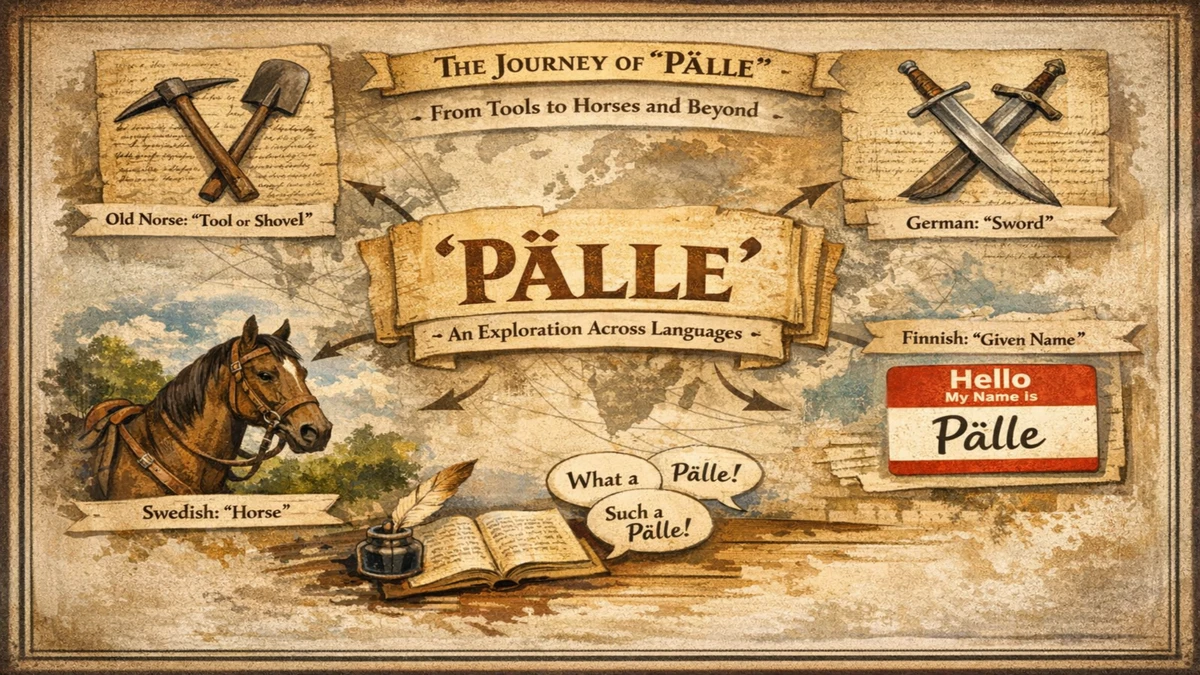
The word pälle looks simple on the page, but it carries a surprisingly complex cultural and linguistic history. Across different languages and regions, closely related spellings such as pallë, pålle, and palle point to very different things: a sword or a farm tool in Albanian, a horse in Swedish dialects, a personal name in Scandinavia, and everyday slang in Italian. None of these meanings cancel the others out. Instead, they reveal how language evolves not as a single, orderly system, but as a patchwork shaped by geography, culture, and human need.
In Albanian, pallë belongs to an older layer of vocabulary tied to material life and history. It names physical objects that once mattered deeply to survival and social order, from weapons to agricultural tools. In Scandinavian speech, pålle is casual and affectionate, used to refer to a horse or to a person named Palle. In Italian, palle becomes lively, expressive, and idiomatic, embedded in everyday conversation.
The presence of similar sounds across unrelated languages is not unusual. Human speech uses a limited set of sounds, and languages often converge on similar forms by chance. What makes pälle interesting is not that it means one specific thing everywhere, but that it means so many different things depending on where you are, who you are speaking to, and what you are trying to describe.
This article traces pälle through its linguistic environments, examining how it emerged, what it means, and what it reveals about language itself. By following this small word across cultures, we can see how vocabulary reflects material life, social relationships, and the creative flexibility of human communication.
Albanian Pallë and the Language of Objects
In Albanian, pallë is a feminine noun with multiple meanings rooted in physical objects. Historically, it referred to a sword, a weapon associated with honor, protection, and warfare. Over time, the same word came to refer to other elongated or striking objects, such as poles, clubs, or agricultural tools used for threshing grain or washing clothes.
This semantic expansion makes sense when we consider how people categorize the world. A sword, a stick, and a flail all share a basic shape and function: they are long objects used to strike, move, or manipulate other things. Language often extends old words to new objects that feel similar in form or use. As swords became less central to everyday life, the word survived by attaching itself to more ordinary tools.
In colloquial Albanian, pallë can even refer to spokes of a wheel or simple wooden bars used to fasten doors. The grand and the mundane share the same linguistic root, reminding us that language does not preserve hierarchies of importance. What matters is usefulness and familiarity.
Scandinavian Pålle and the Language of Affection
In Swedish dialects, pålle is a casual term for a horse. It is not formal or technical, but warm and colloquial, the kind of word a child might use at a farm or stable. Here, the word is not tied to tools or weapons, but to animals and relationships between humans and working creatures.
At the same time, Palle exists as a given name in Scandinavian countries, often understood as a diminutive or variant related to Peter. In this form, the word is no longer descriptive but identificatory. It marks a person, not an object or animal, and it participates in traditions of naming, family, and identity.
The Scandinavian usage shows how a phonetic form can become emotionally charged. A word for a horse evokes care, labor, companionship, and rural life. A name evokes individuality and belonging. The sound remains similar, but the meaning shifts entirely with social context.
Italian Palle and the Language of Expression
In Italian, palle is the plural of palla, meaning “ball.” On the surface, this is simple and concrete. But Italian culture has turned the word into a rich field of idiomatic expression. It appears in phrases that convey frustration, emphasis, boredom, or intensity, making it part of the emotional texture of speech.
Unlike Albanian pallë, which is tied to tools, or Swedish pålle, which is tied to animals or names, Italian palle is tied to feeling and expression. It shows how words can migrate from naming objects to expressing inner states.
This kind of semantic shift is common across languages. Words for body parts, tools, or simple objects often become metaphors or idioms. Over time, speakers forget the literal origin and focus on the emotional or social function.
Comparative Overview
| Variant | Language | Meaning | Cultural Role |
|---|---|---|---|
| pallë | Albanian | Sword, pole, tool | Material and historical |
| pålle | Swedish | Horse (colloquial) | Affectionate, rural |
| Palle | Scandinavian | Given name | Identity, family |
| palle | Italian | Balls, slang | Expressive, idiomatic |
The table shows that phonetic similarity does not imply shared meaning. Each variant lives inside its own cultural system.
Expert Reflections
Dr. Ingrid Larsson, a comparative linguist, observes that similar sounds across languages often arise independently. “What gives words meaning is not their sound but their social use,” she explains. “The same sequence of sounds can carry entirely different histories and emotional weights.”
Professor Marco Rinaldi, a Romance linguist, notes that Italian slang illustrates how language absorbs and reflects cultural temperament. “Words become expressive tools,” he says. “They are shaped by humor, emotion, and everyday interaction.”
Anthropological linguist Sara Meyers emphasizes material culture. “When societies change how they work, fight, or farm, their vocabulary changes too. Old words find new homes.”
Language Change Over Time
The journey of pälle shows how language evolves not through planned reform but through daily use. Objects disappear, professions fade, and social practices shift, but words persist by adapting. A sword becomes a stick, a stick becomes a household tool, a tool becomes a metaphor.
At the same time, unrelated languages produce similar sounds that take on local meaning. This convergence is not evidence of a shared origin, but of the limited palette of human speech and the infinite creativity with which humans use it.
Cultural Meaning and Identity
Words like pälle remind us that language is not only a system of signs but a record of human life. Each meaning reflects a way of living: farming, riding, naming children, expressing emotion. By studying such words, we glimpse how people organize their world and what they value.
Takeaways
- pallë in Albanian reflects material life and history.
- pålle in Swedish reflects affectionate rural speech.
- Palle as a name reflects identity and tradition.
- palle in Italian reflects expressive culture.
- Similar sounds do not guarantee shared meaning.
Conclusion
The story of pälle is not the story of one word, but of language itself. It shows how sounds travel, meanings shift, and cultures imprint themselves on vocabulary. A sword becomes a stick, a stick becomes a tool, a tool becomes a metaphor, and a sound becomes a name.
By tracing this path, we see that language is not static. It is alive, shaped by work, love, humor, and history. Even the smallest word can open a window onto the vast complexity of human life.
FAQs
What does pallë mean in Albanian?
It can mean a sword, a pole, or a tool, depending on context.
What does pålle mean in Swedish?
It is a colloquial word for a horse.
Is Palle a personal name?
Yes, in Scandinavian countries it is used as a given name.
Is Italian palle related to Albanian pallë?
No, they sound similar but have different origins.
Why do similar words exist in different languages?
Because languages reuse similar sounds independently.
References
- Wiktionary. (2025). pallë. Retrieved from https://en.wiktionary.org/wiki/pall%C3%ABWiktionary
- Wiktionary. (2024). pålle. Retrieved from https://en.wiktionary.org/wiki/p%C3%A5lleWiktionary
- Name Doctor. (2020). Pälle Name Meaning & Origin. Retrieved from https://www.name-doctor.com/meaning/palle-27856name-doctor.com
- Which Way to Rome. (2012). Word of the Day: Palle, and co. Retrieved from https://whichwaytorome.com/2012/03/23/word-of-the-day-palle-and-co/Which Way To Rome
- Wikipedia. (2025). Palle (given name). Retrieved from https://en.wikipedia.org/wiki/Palle_%28given_name%29