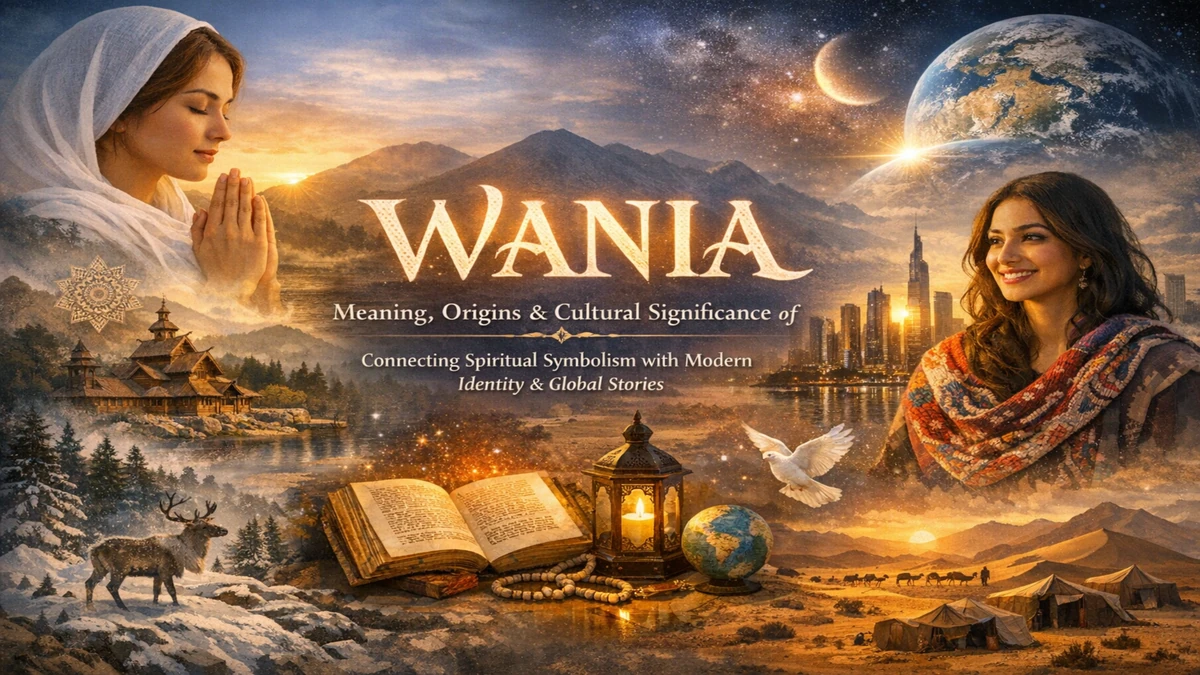
Wania is a personal name with layered meanings, cultural depth, and real-world presence across societies, languages, and professions. At its core, Wania is understood as a name associated with spiritual gentleness and divine blessing, commonly interpreted as “a gentle breeze” or “a gift from God.” These meanings are not abstract linguistic curiosities; they shape how families choose the name, how individuals relate to it, and how communities recognize it. The name functions as a bridge between the sacred and the everyday, between inherited tradition and lived identity.
Across Muslim communities, Wania is valued for its positive spiritual associations and its soft, lyrical sound. In South Asia, the Middle East, and diaspora communities worldwide, it is chosen not only because of its meaning but because of what that meaning represents: calmness, grace, and divine generosity. Over time, Wania has also become visible in global public life through individuals in sport, music, and other fields, demonstrating how a culturally rooted name can travel far beyond its original context while retaining its symbolic core.
This article explores Wania as a linguistic form, a cultural practice, and a social identity. It traces its meanings, examines how names function in human societies, looks at notable people who carry the name, and reflects on why names like Wania continue to matter in a world where identity is increasingly global but still deeply personal.
Read: Understanding Anonib: The Rise and Fall of Anonymous Imageboards
The Linguistic and Spiritual Roots of Wania
The name Wania is most often associated with Arabic linguistic roots and Islamic naming traditions. One widely accepted interpretation connects it to a root conveying softness, ease, or gentle movement, which leads to the poetic meaning “gentle breeze.” Another widely used interpretation, particularly in South Asian contexts, translates Wania as “God’s gift,” emphasizing divine generosity and blessing rather than physical imagery.
These dual meanings are not contradictory. In many religious and poetic traditions, natural imagery such as breeze, light, or water is used to symbolize divine mercy and grace. A gentle breeze cools, refreshes, and sustains life, just as divine favor is believed to sustain the soul. This metaphorical richness is one reason why Wania resonates across cultures and languages even when exact translations differ.
Over time, the name has been adapted into different scripts and phonetic systems, including Arabic, Urdu, Tamil, and English transliterations. Each adaptation preserves the sound and spiritual intent while fitting into local linguistic norms. This flexibility allows Wania to function both as a culturally specific name and as a globally intelligible one.
Names as Cultural and Social Symbols
Names are among the first cultural gifts a person receives. Sociologists and anthropologists describe names as “compressed narratives” that carry family histories, religious beliefs, social aspirations, and cultural memory in a single word. Choosing a name like Wania is rarely a neutral act. It reflects values, hopes, and identities that parents wish to pass on.
In religious contexts, names often function as moral or spiritual signposts. A name that means “God’s gift” implies gratitude, humility, and a sense of purpose. It frames the child not as an isolated individual but as part of a divine and social relationship. In poetic contexts, a name like “gentle breeze” suggests calmness, kindness, and emotional softness, qualities that communities often admire and encourage.
In modern societies, names also play a role in how individuals are perceived in educational, professional, and social settings. Research in social psychology has shown that names can influence expectations, assumptions, and even opportunities. A name like Wania, which is relatively uncommon in many Western societies, may mark someone as culturally distinctive, prompting curiosity, conversation, or sometimes misunderstanding. At the same time, that distinctiveness can become a source of pride and identity.
Wania in Global Context
As migration and globalization increase, names travel. Wania is now found in communities across Europe, Africa, North America, and Australia, often carried by families who have moved from Muslim-majority regions or who have embraced the name for its beauty and meaning.
This global movement changes how names function. In their original cultural contexts, names like Wania may blend seamlessly into the naming landscape. In new contexts, they can become markers of heritage, connecting individuals to ancestral cultures even when daily life is shaped by different social norms. For many in diaspora communities, keeping a traditional name is a way of preserving continuity in the midst of change.
At the same time, names like Wania can also be adopted outside their original cultural frameworks. Some parents choose them simply because they sound elegant, unique, or meaningful, even if they do not share the religious or cultural background traditionally associated with the name. This creates a second layer of cultural life for the name, where it becomes part of a shared global vocabulary rather than a single cultural tradition.
Notable Individuals Named Wania
While many people experience Wania as a private family name, it also appears in public life through individuals who have achieved recognition in their fields. These figures demonstrate how a name rooted in spirituality and culture can become associated with excellence, discipline, and creativity.
One prominent example is Wania Monteiro, a rhythmic gymnast from Cape Verde who became the first athlete from her country to compete in rhythmic gymnastics at the Olympic Games. She represented Cape Verde in the 2004 Athens Olympics and again in the 2008 Beijing Olympics, later serving as her nation’s flag bearer. Her career symbolized not only personal achievement but also national representation and the expansion of opportunities for athletes from smaller or less resourced countries.
Another figure is Dominik Wania, a Polish jazz pianist and composer known for blending classical technique with contemporary improvisation. His work has been praised for its technical precision and emotional depth, and he has collaborated with internationally recognized musicians. Although his cultural background differs from that of Wania Monteiro, the shared name illustrates how a single word can link lives across continents and disciplines.
These examples show that while names originate in specific cultural and linguistic contexts, their social meanings evolve as people carrying those names shape the world around them.
Expert Perspectives on Names and Identity
Dr. Amina Khalid, a sociolinguist who studies naming practices, describes names as “one of the most durable forms of cultural transmission.” She argues that even when languages change and traditions shift, names often remain, preserving traces of older meanings and values within modern societies.
Cultural anthropologist Rashid Al-Masri notes that names with spiritual meanings often function as ethical reminders. In his view, “a name like Wania does not just label a person, it frames a relationship between the individual, the family, and the divine, shaping expectations about character and conduct.”
Historian Leila Ahmed adds that in diasporic contexts, names can become tools of resistance against cultural erasure. By keeping a name like Wania, families assert continuity and belonging, even when surrounded by different dominant cultures.
Together, these perspectives show that names operate simultaneously on linguistic, psychological, social, and political levels. They are not passive markers but active elements of identity formation.
Wania and Personal Identity
For individuals named Wania, the name can become a focal point of self-reflection. Some may feel a strong connection to its spiritual meaning, seeing it as a reminder of gratitude or purpose. Others may simply enjoy its uniqueness or musical quality. In both cases, the name becomes part of how they narrate themselves to the world.
In multicultural environments, people often explain their names to others, turning a simple question into an opportunity for cultural exchange. “What does your name mean?” becomes a gateway to conversations about language, religion, migration, and family history. In this way, Wania becomes not only a personal identifier but also a social connector.
At the same time, the experience of carrying a culturally distinctive name can involve challenges. Mispronunciations, misunderstandings, or stereotypes can create moments of discomfort. Yet many individuals also describe these moments as opportunities to assert identity and educate others, transforming potential obstacles into moments of connection.
Takeaways
- Wania is a name associated with meanings such as “gentle breeze” and “God’s gift,” linking natural imagery with spiritual symbolism.
- It originates in Arabic and Islamic naming traditions but has been adapted across languages and cultures.
- Names like Wania function as cultural symbols that transmit values, beliefs, and identity across generations.
- Global migration has transformed Wania into both a heritage marker and a shared global name.
- Notable individuals named Wania demonstrate how a name can become associated with excellence and achievement.
- Names influence self-identity, social perception, and cultural continuity.
Conclusion
Wania is more than a sound or a word. It is a vessel of meaning, carrying spiritual poetry, cultural memory, and personal identity across time and space. Its interpretations as a gentle breeze or a divine gift reveal how language uses metaphor to express what is valued most deeply: grace, kindness, and blessing. As the name travels across borders and generations, it gathers new stories without losing its original resonance.
In a world where identities are increasingly fluid and global, names like Wania remind us that individuality is always shaped by history and community. They show how the personal and the collective intertwine, how a single word can connect families to faith, cultures to one another, and individuals to their own sense of self. Wania endures not because it is rare or exotic, but because it speaks, quietly and persistently, to universal human longings for meaning, belonging, and grace.
FAQs
What does the name Wania mean?
It is commonly interpreted as “gentle breeze” or “God’s gift,” combining poetic imagery with spiritual symbolism.
Is Wania a religious name?
It is often used in Muslim communities and linked to Arabic and Islamic traditions, though it can be used outside religious contexts.
Is Wania used globally?
Yes, it appears in many countries through migration and cultural exchange and is sometimes chosen for its sound and meaning.
Are there famous people named Wania?
Yes, including a Cape Verdean Olympic gymnast and a Polish jazz pianist, among others.
Is Wania typically a female name?
It is most commonly used as a female given name, though naming practices vary by culture.